What makes a good photobook?

Article main image

As someone who has spent a lot of time with photobooks — presenting them online, teaching how to make them, writing about them in a critical fashion, making them myself, over the years the most common question has been: what makes a good photobook? What is it that makes some books so much better than others?

Inevitably, I have struggled with providing an answer to a seemingly simple question that at its core betrays all kinds of other agendas. Mostly, though, it’s an impossible question to ask without taking into account one’s own preferences, ideas, and circumstances.

It’s a bit like asking what makes a perfect meal. Everyone could possibly name that one dish they really love; but it will still have to be made in just the right fashion and then enjoyed under just the right circumstances.

For some time, I was using a rating system for photobooks. If the world of music can live with detailed ratings, I thought, the world of the photobook can as well. Not so.

I still think that the system had considerable value, in particular since it forced me to engage with every book on as similar a footing as possible.  The way the ratings were constructed, for every book I had to look at a set of details; and in almost every case, without being made to do so I might have overlooked something.

But with time I came to understand that there was still something missing, and I’ve always wondered what that missing bit might be.

I can’t say that I have the answer, yet (I probably never will). But I do think that I recently got a lot closer to understanding what makes a good photobook.

It’s character.

Character might not be the perfect word. In this particular context, it describes the overall feel I get from a book. It’s a combination of all of the various aspects that go into bookmaking.

Crucially, though, on their own these aspects are actually quite meaningless.

For example, you could only publish what you think is the best photography — and still end up with mostly not very interesting books. You could use what is widely considered the best production for a book — and still end up with mostly not very interesting books. Or you could hire the fanciest designers, chasing the latest tricks in graphic design — and still end up with mostly not very interesting books.

My inner editor tells me not to provide examples of publishers for these cases, mostly because at least to some extent, books are also a matter of taste and of understanding some of the aspects of book making (in photoland, maybe the most widely mis- and/or poorly understood aspect of book making is graphic design).

Instead, I can give you examples of publishers who in my book (pardon the pun!) nail photobook making. There is, for example, FW:Books. It’s not that I like every book they make. Many simply do not speak to me. But even the books that do not speak to me hold their own. They’re extremely well produced, and even if I don’t like the photography or idea, they make me engage with them.

Books made by FW:Books have character. Of course, it is a very specific character, and it connects with what I want to see in a photobook. Another publisher that immediately comes to my mind is Van Zoetendaal.

Lest you think it’s the Dutch bookmaking that’s responsible for this: it is not.

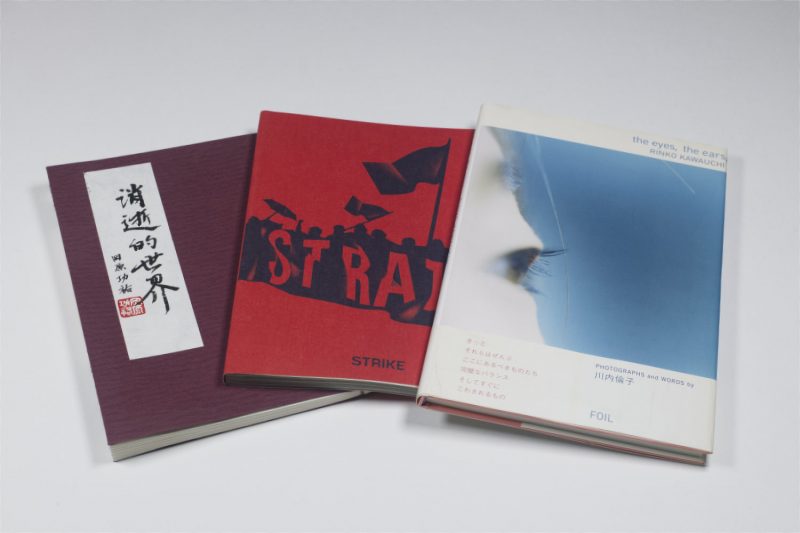
If you look at the three books I decided to feature as examples in the photograph at the top (Kosuke Okahara’s Vanishing Existence [self-published, 2013], Rafal Milach’s Strajk [Jednostka, 2021], and Rinko Kawauchi’s the eyes, the ears, [Foil, 2005]), you have three very different books that for me have enormous character even though they were made in very different fashions.

Okahara’s Vanishing Existence was hand-made. Milach’s Strajk was printed on “cheap” newsprint. Kawauchi’s the eyes, the ears, is “just” a regular mass production (it’s not even the first edition — not that this matters, given that all editions are identical).

With all of these books — and the various other books I own that I treasure so much for the same reasons — enormous character shines through, which, and this is important to me, communicates the artists’ integrity.

That’s the thing: if a book does not have much (or any) character, it’s just so much harder for the work (meaning not the photographs as individual items but the totality of the presentation) to have the integrity it might deserve.

The question of arriving at a book with character has to start with the photographer her or himself. You will have to know what you need for a book to communicate and for the package to shine — in other words for it to have character.

For you, as the reader of these words, the answer which books have the character you’re looking for might be very different than for me. And the question of character is not limited. With time, it is likely to change.

Of course, endless argument over what essentially is merely a question of taste will never end. But ultimately, they’re pointless. Someone’s favourite pizza might be someone else’s hot circle of garbage (to quote a character from the US TV show The Office).

Thus, instead of asking what makes a good photobook, you need to start out by asking what you are looking for and what you are responding to — and why. At the same time, you need to start to understand what it is in photobooks that other people respond to.

Inevitably, you will need to learn what exactly good printing is (and what is not); but you then also need to understand that fetishizing good printing does not guarantee a good book. The same is true for graphic design or whatever else.

With all of the many variables involved, it is next to impossible to say what a good photobook is. There is no formula to artistic success.

All you can do is to take books and appreciate them for what they do individually — to see whether they have character or, which is sadly much too common, whether they lack something.

It’s way past the point where writing the following will change anything. But the explosion of endless photobook “shortlists” with often dozens of entries demeans the actual experience anyone can have with photobooks. It’s neoliberalism at its absolute worst.

Instead of judging books by where they’re placed in some random list approach them to learn more about the people who made them. The good books, the ones with a lot of character, will tell you.

And that’s what makes it all worthwhile.

If you enjoyed this article, please consider subscribing to my Patreon. There, you will find exclusive articles, videos, and audio guides about the world of the photobook and more. For those curious, there now is the possibility of a trial membership for seven days.

Much like journalism, photography criticism involves a huge investment of time and resources. When you become a subscriber, you not only get access to more of my work. You will also help me produce it (including the free content on this site).

There also is a Mailing List, which I use to send out supplementary materials — anything that has me inspired or that somehow seemed worth noting. Some of it is serious, some is not. You can sign up for free here.

Thank you for your support!
Afghanistanism

Article main image

Almost twenty five years ago, a few days after 9/11, I went to a restaurant serving food from Afghanistan. At the time, I still lived in Boston, from which two of the planes had departed that were used in the terrorist attacks. For a while, it was not clear whether Boston itself would be a target, so local employers sent people home.

All air traffic had been suspended, meaning that for the first time I saw the crisp blue sky over the city without any trails left by departing planes. Instead, there was a single fighter jet circling over the city: You could tell that something had broken, even if at the time it was impossible to tell what would emerge next.

It quickly became clear that the response to the attack would be very violent. Afghanistan, which served as the base of the terrorist group behind 911, was going to be the target. The question was not whether there would be violence but how much. Even as the window of critical discourse was closing very rapidly, it was clear to many people that Afghanistan, a country that nobody knew much (if anything) about, would get attacked.

That restaurant I went to was filled with people, and I remember it being very quiet, very somber. It was obvious that everybody had come for the same reason, the kind of helpless attempt to show solidarity with a people who had now become the symbol for something they were not actually responsible for.

And things would get a lot worse as what ended up being termed The Global War on Terrorism (as if abstract concepts were entities you could attack) started to consume the country.

Whatever you want to say about contemporary photography and its many faults, you will have to admit that the books made by photographers about the war and its consequences created powerful records of a time and place that now feels far removed already.

The reality is that there is only so much photographic books can do, given that, well, their audience forms a small niche. But the books made by Peter van Agtmael or Ben Brody clearly delineated how the United States engaged in a circle of violence that would destroy some of its own civic fabric and reduce vast parts of Aghanistan (and Iraq) to ruins.

What these books did not do, though — and just to be very clear, this is an observation and not a form of negative criticism — is to look at Afghanistan (which ended up only the first major battleground in George W. Bush’s ill-fated wars) as more than the stage on which the United States staged its drama.

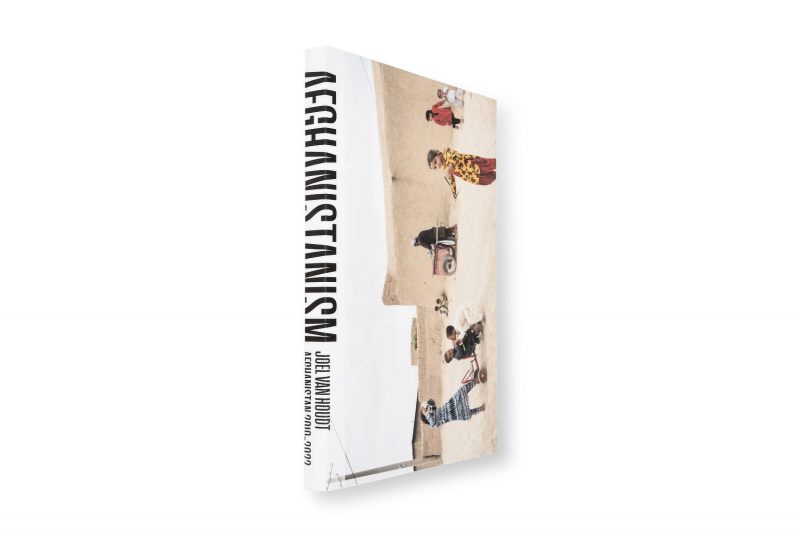
What about the country itself — Afghanistan? Joël van Houdt‘s new book Afghanistanism attempts to get closer to an answer to that question. An independent photojournalist, Van Houdt photographed the country for 12 years (for five years, he was stationed there), and the book is a distillation of his efforts.

There is much that can be said about photojournalism, and this is not necessarily the forum to do that. With its crooked horizon lines and its endless close-up depictions of yelling and/or crying people (depending on context mostly people who inevitably will be perceived as vaguely threatening for a Western audience) photojournalism keeps churning out a steady stream of visual clichés; and yet I personally still believe that it has value, in particular in the hands of practitioners like Van Houdt who attempt to avoid rehashing the same tiresome conventions in every picture.

“I was interested,” Van Houdt writes in his Postscript, “in documenting the consequences of some of the richest countries, including my own of the Netherlands, invading one of the poorest. […] Most of the photographs in the book were taken when I was not on assignment but during the thousands of hours I spent walking with no specific goal or direction in mind.”

In the Postscript, the photographer is upfront about the challenges faced by anyone doing such work. “I mostly stuck to walking in areas I deemed relatively safe,” he writes, “where I felt welcome.” And he acknowledges the difficulty of possibly getting access to the lives of women, given the complexity of the circumstances.

I personally believe that this it the right approach for a topic such as this one: There is considerable insight to be gained from it despite its limitations. A viewer looking at photographs will always have to be aware of their makers’ limitations. All photographs are the decisions of any number of decisions, which include something — and exclude a whole lot more.

When looking through the book, I was struck by the breadth of its vision. While I do look at a lot of photographs, I cannot be considered an expert on Afghanistan and how it has been depicted. Still, I find it difficult to ignore what comes across as a genuine curiosity on the photographer’s part to pierce through the veil created in part by the cliché conventions of his field.

In the end, Afghanistanism succeeds in embedding what is familiar for a Western audience with a lot more that is not (“embedding” a as word choice might seem unfortunate here, but I will stick with it).

The book comes with a large number of quotes about foreigners waging war in Afghanistan and describing what they encountered and/or thought. I’m slightly torn about the inclusion of these quotes in part because I think that the work itself (by which I mean the photographs) does not actually need it.

Of course, it is good to understand the degree with which the country has been a stage for war (and I suppose that there actually are plenty of people who don’t know this). But I do think that even without the quotes, it would become very clear to a viewer to what extent the richness of Afghanistan has been trampled on by outsiders bringing their wars there (for whatever reasons).

The book is the kind of wonderful production one by now can expect to emerge from the Netherlands, which definitely helps to communicate the photographer’s goals.

And it is now being released into a world that seems to have changed much, even if in actuality only four short years have passed since Van Houdt last went to Afghanistan. The Taliban are back in power, and countries such as Germany (one of the rich nations that sent its soldiers there) are now working with them to deport unwanted refugees (I am not making this up: “German Interior Ministry officials travelled to Afghanistan in 2025 to discuss the practicalities of deportation,” notes this article).

If anything, Afghanistanism serves as a reminder that that busy stage used for the Global War on Terror was and still is actually inhabited by ordinary people whose hopes, dreams, and aspirations are just as human as everybody else’s (their governments’ efforts notwithstanding). The often poignant photographs in the book drive this point home in a fashion that’s almost too hard to bear.

Recommended.

Afghanistanism; photographs and text by Joël van Houdt; 276 pages; self-published; 2026

If you enjoyed this article, please consider subscribing to my Patreon. There, you will find exclusive articles, videos, and audio guides about the world of the photobook and more. For those curious, there now is the possibility of a trial membership for seven days.

Much like journalism, photography criticism involves a huge investment of time and resources. When you become a subscriber, you not only get access to more of my work. You will also help me produce it (including the free content on this site).

There also is a Mailing List, which I use to send out supplementary materials — anything that has me inspired or that somehow seemed worth noting. Some of it is serious, some is not. You can sign up for free here.

Thank you for your support!
Cut Out

Article main image

A well known curator once said that the problem with collage was that it’s too easy to make a decent one, while it’s almost impossible to create something great. Whether or not I am misremembering or paraphrasing I am not sure. But collage seems easy, and the fact that it lends itself to exercises in graphic design certainly does not help.

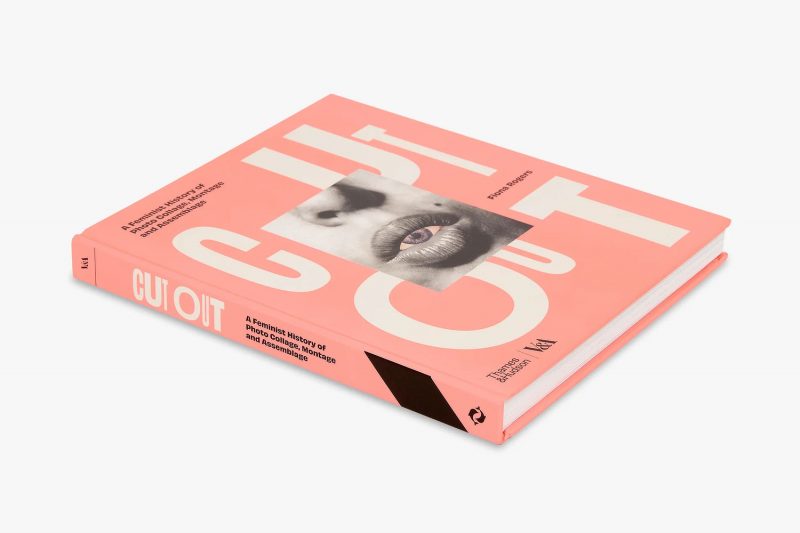
Over the years, I have seen a few good books about collage — but nothing great, nothing providing deeper insight of any sorts (besides, possibly, here and there very minor art history which often is mixed with some surface-level knowledge of world history). But now there is Cut Out, subtitled A Feminist History of Photo Collage, Montage and Assemblage, by Fiona Rogers (a photography curator at London’s V&A).

“Art history,” Rogers writes, “suggests a habitual, inherently gendered separation of collage techniques: the conceptual ‘high’ art for by Picasso and Georges Braque in 1912, and the ‘low’ craft or hobby version, defined by an aesthetic or technique and (mostly) practiced by women. The erasure of these latter forms combined with the repetitive, self-perpetuating nature of art history (and those who write it) ensures that such distinctions are upheld and maintained.”

And thus Rogers proceeds to set the record straight, not only by centering the many contributions by women artists (some of them in my book the defining collage artists) but by also compiling a proper art-historical survey of collage from its very beginnings up until the present time.

I particularly enjoyed the book’s broadening of the idea of collage and its practitioners both in the relatively distant past and in the present immensely.

You might wonder about collage in this day and age where everything has seemingly gone digital and where print media — once the main source of material for collages — have been hugely diminished.

But collage is a principle more than a set of laws, and in the hands of someone with talent and a vision, everything can be brought into the present.

As is usually the case with surveys, Cut Out is structured through a series of chapters (that come with an introduction by Rogers), with supplementary, slightly more detailed study cases added (these feature introductions/text by a variety of authors).

The V&A collection forms the reservoir from which Rogers extracts the material in the book. No doubt there are holes in that collection. However, as is the case with every survey book, someone will always miss something and/or question the inclusion of something else.

In any case, the strength of a survey book is not necessarily formed by the richness of its source material (even though it is rich here [I am unable to decide whether the pun is intended or not) but by the framework the curator manages to construct around it.

The framework constructed by Rogers is very strong, enabling a viewer/reader to approach the broader landscape of collage with a much wider view for its potential, its possibilities, and the various underlying strata that might determine how or why we see what we see.

This is what for me forms the backbone of a survey book: it should not necessarily feed me with data — names and the like (even though it certainly is wonderful to have this aspect provided as well). Instead, I expect it to enable me to see and understand more widely.

The moment you make someone not only see but understand more widely, you allow them to question their own ideas, effectively outsourcing the discussion around the inclusion and/or exclusion of someone.

In other words, a good survey book is less a lecture for a passive audience than an introduction to a (hopefully) shared passion of inquiry.

And this is an excellent survey book that, I suspect, might form the basis for how collage will be discussed for a long time.

Crucially, the book provides the only possible retort to the assertion I started out this article with: yes, collage looks easy (I mean, come on now, photographers, pressing a shutter button is even less work), yes, it is very much possible to make great collages, and yes, collage can be an incredible medium to speak about aspects of our troubled times.

As the artists featured in the later sections demonstrate, the potential of collage art has not yet been fully explored, and it probably never will be. This fact provides an opening for anyone for whom photography on its own might be too limiting.

And it doesn’t really matter how exactly you might go about making your collages — whether digitally or in a physical fashion — as long as you manage to not only give expression to what drives you but also push the boundaries of expression itself. I suspect that it is especially the latter that might surprise many viewers/readers unfamiliar with, say, Dafna Talmor, Sheida Soleimani, or Cecilia Mandrile.

Recommended.

Cut Out: A Feminist History of Photo Collage, Montage and Assemblage; with essays by Fiona Rogers (ed.), Damarice Amao, Matthew Biro, Justine Kurland, Melissa Meyer, Renée Mussai, Pelumi Odubanjo, Alona Pardo, Tania Sanabria; 240 pages; Thames & Hudson; 2026

If you enjoyed this article, please consider subscribing to my Patreon. There, you will find exclusive articles, videos, and audio guides about the world of the photobook and more. For those curious, there now is the possibility of a trial membership for seven days.

Much like journalism, photography criticism involves a huge investment of time and resources. When you become a subscriber, you not only get access to more of my work. You will also help me produce it (including the free content on this site).

There also is a Mailing List, which I use to send out supplementary materials — anything that has me inspired or that somehow seemed worth noting. Some of it is serious, some is not. You can sign up for free here.

Thank you for your support!