Photography comes with its own logic. By that I mean that there is a general expectation why photographs might have been taken, whether to document a moment, to preserve it, or whatever else. What if that logic is broken, though? What if a set of photographs resists interpretation along the kinds of standard avenues that are generally used?
As a vehicle for such an approach, the photobook is particularly well suited. With explanatory text usually absent, a photobook relies on its photographs alone to establish the world it aims at creating for its viewers. This basic fact makes creating a photobook difficult; at the same time, it provides the basis for the possible enjoyment or satisfaction a viewer might experience.
The key to understanding a photobook is to realize that it will contain its own logic. While a viewer does not know what exactly is going to happen (and how) solely through the use of photographs the book will reveal itself to them. All they have to do is to submit to the book’s logic — instead of fighting it or expecting something else.
For me, this is the main reason why I still look at photography even though my interest in the medium has cooled considerably: As far as I am concerned, the photobook is the only place in the world of photography where artists are still attempting to push the boundaries of photographic expression (well some of them anyway).
Of course, I am not looking for and/or expecting to be faced with such attempts all of the time. That would be unrealistic, given that most photographers cluster around sameness; and it would probably be exhausting as well.
Still, every once in a while I want to face something that I have not experienced before. I simply want to see that in that seemingly endless sea of sameness there are those who strive to aim for something different. Different — not better: art is not a competition.
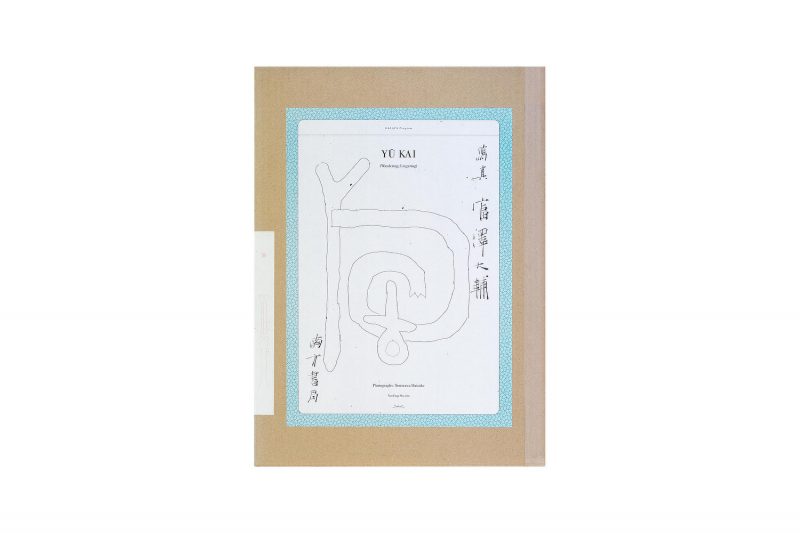
The most recent book I encountered that fits into what I outlined above is Daisuke Tomizawa’s Yū-kai. The book presents a large number of colour photographs that come in pairs and that show a large mix of broader subject matters (landscapes, fragments of cityscapes, still lifes, etc.).
It’s not immediately clear whether a viewer’s desire to classify what is on view in the book is a particularly useful approach, given that the more you attempt to squeeze the book into what you already know, the less sense things will make.
But the book does makes sense, as long as you accept it on its own terms. If at first you are unable to see how this might be true, you will have to keep looking, always reminding yourself that the book needs to be understood not based on parameters set outside of it.
There are many pictures in Yū-kai that you wouldn’t expect to find elsewhere. Typically, photographers discard pictures that are a little bit blurry or out of focus, and they discard pictures whose compositions are a little bit off. Here, they are included.
What makes this particular book so interesting on a cerebral, conceptual level is that it clearly should not work. You cannot make a book that has no subject matter, and you certainly cannot make a book many of whose photographs refuse to conform to the conventions the world of photography takes for granted.
And the reality is that, yes, you cannot do that. If you try — I imagine teachers in undergraduate programs all over the globe who might be reading these words collectively nodding — you will fail.
But no, you can do this if — and this is simply the very basis of photobook making — everything on view in the book is in service of the larger goal: to create a world that has its own logic.
Again, this is why photobooks ultimately are a much more interesting approach to photography itself than individual pictures: even with seemingly the most sophisticated ideas, your photographs will always only be one offs that take very little effort to see through (you can construct all kinds of verbiage around them, but that still doesn’t add up to much).
The book transcends the relative simplicity of its individual constituent photographs and has them build on each other and with each other to create a world that even the most sophisticated staged-narrative photography has no chance of even remotely getting at.
The key to all of the above is to focus on that world; inevitably, this means asking yourself whose world this might be. It’s not necessarily the photographer’s, even though of course it might be.
Where things get more interesting is where that other world implies the presence of someone or maybe something else. (Obviously, these observations are completely trivial in the world of fiction writing.)
So who is looking at this world? Who is looking at Japan in Yū-kai‘s fashion? It’s not clear, even though what is clear is that it’s not one of us.
This is not one of those books in which a photographer revels in his particular idea of visual cleverness (not that there’s anything wrong with that approach; it’s just that I personally find it mostly tedious). Instead, as a viewer you end up with the feeling of being somewhat lost, of being or rather feeling disconnected from a world that you would prefer to be closer to. This is not a tease on the book’s part. Instead, it feels real.
If you remember that we share this world with all kinds of other creatures, you might find a good way to approach the book. We will likely never know how our pets, say, see the world, even if scientists somehow might be able to construct their vision. But vision itself is not what constitutes seeing. Or rather seeing involves a lot more than vision.
“If a lion could talk,” Ludwig Wittgenstein once wrote, “we could not understand him.” I’m living with two male cats, one of which appears to think of himself as a lion (or does he?). We communicate on a daily basis. Do we understand each other? Mostly (I would love to think). But when we look at each other, it’s hard not to notice that gulf of incomprehension that lies just beyond the endless mutual affection.
You don’t have to look at Yū-kai as if it presented the world as seen by a cat. The vision is much closer to a human’s. But while it is close to a human’s, it does not necessarily feel as if it were perfectly aligned with it.
And that little gap there — the more you see it in the pictures, the most it opens up, letting us know that even though we think that we understand this world, we actually don’t.
Recommended.
Yu-kai; photographs by Daisuke Tomizawa; essay by Xue Xiaodan (Japanese language only); 192 pages; Nan Fang Shu-chu; 2023
If you enjoyed this article, please consider subscribing to my Patreon. There, you will find exclusive articles, videos, and audio guides about the world of the photobook and more. For those curious, there now is the possibility of a trial membership for seven days.
Much like journalism, photography criticism involves a huge investment of time and resources. When you become a subscriber, you not only get access to more of my work. You will also help me produce it (including the free content on this site).
There also is a Mailing List, which I use to send out supplementary materials — anything that has me inspired or that somehow seemed worth noting. Some of it is serious, some is not. You can sign up for free here.
Thank you for your support!