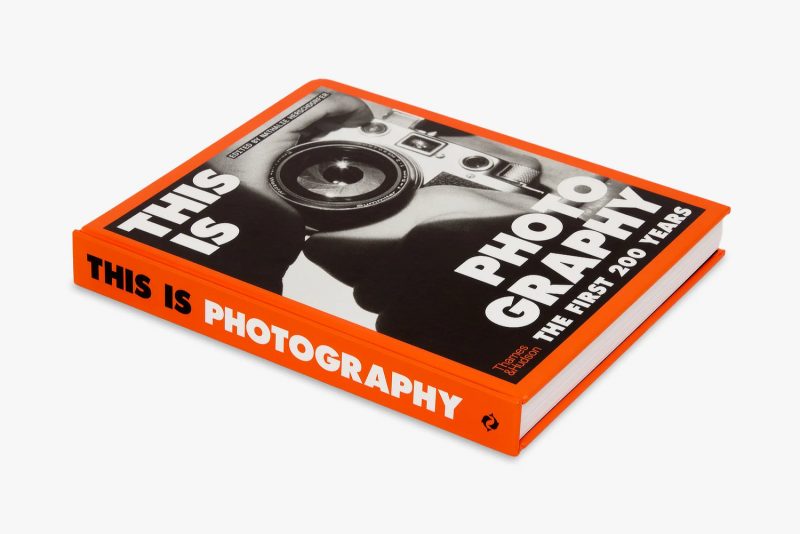
In 1826, Joseph Nicéphore Niépce used a camera obscura to produce what is widely viewed as the first photograph, an incredibly hazy view of some houses. This fact would make the medium of photography 200 years old, which is why Nathalie Herschdorfer, a Swiss curator and director of Photo Elysée, produced This Is Photography: The First 200 Years.
The problem with photography is that it was invented the wrong way around, which makes the writing of histories more complicated than it should be. By this I mean that you have a much easier time looking at photography today and then going back in history to understand what is going on than by looking at the various fits and bursts with which the medium started and by then trying to make sense of it all.
The second problem is that on its own, photography has no meaning. If you focus on its artifacts, the photographs, you might arrive at all kinds of conclusions. But those conclusions tend to be flawed, given that in order to understand what photography is you have to look at what photography does. And you can only understand what photography does by looking at the contexts in which it operates.
Frustratingly, photoland largely ignores these two problems and, instead, tries to understand photography only from its artifacts, artifacts that are viewed mostly untethered from the often multiple contexts they operate in. I’m writing “mostly” because especially these days, context — or rather a somewhat tepid admission of context — does enter into considerations of photography, as This Is Photography demonstrates.
The reality is that you cannot ignore context completely, given the larger discussions in photoland — however broad and often toothless they are. The standard solution for this conundrum is what I tend to refer to as the Family of Man approach, which acknowledges the various complexities swirling around photographs and what they depict.
That acknowledgment is done in an extremely well intentioned fashion (you see, for example, wars exist, alas). But the many rough edges that enter into the conversation that way are then furiously sanded down to create something smoothly polished.
This Is Photography mentions any number of often glaring problems or issues. For example, in the section entitled Photography In the Service of Anthropology (1884), we find the following. “The colonialist concept of photography as a tool for anthropometric data-gathering can be seen in the standardized format of the portraits, which frame the Sámi sitters as scientific specimen. However, despite the unequal power relations between photographer and subject, the sitters were able to assert some individuality through their choice of closing, pose and expression.”
That second sentence blew my mind. Not only does it directly contradict parts of the first — which one is it now, a “standardized format of the portraits” or “sitters [being] able to assert some individuality”? — it also solves the overall problem by offering the viewer (in all likelihood someone living in a previous colonial power) a convenient way out by treating what clearly is an interpretation — “the sitters were able to assert some individuality through their choice of closing, pose and expression” — as a solution to the problem of a human being getting reduced to an inferior scientific specimen in the name of colonialism.
I also really want to know more about “the unequal power relations between photographer and subject” because that’s exactly where all the juice is! But no, after this rather casual mention, it just gets dropped. Oh well!
In other words, This Is Photography allows for just enough pearl clutching that the strings in the precious necklace won’t break. We need to feel bad (for all the right reasons), but we shouldn’t really feel too bad about it all (because, after all, photography museums cannot alienate their clientele and books need to be sold).
However, it would be a mistake to dismiss This Is Photography as only the white washing of photography’s history that in part it is (for the reasons outlined above). As I noted, photography can only be understood in context: the use of photographs tells us something not only about those pictures themselves but also, and more importantly, about the context in which they are being used.
In effect, the book gives expression to how larger parts of the West — as exemplified by the people who frequent Photo Elysée — see themselves and express their self-image through how they approach and treat photography.
If you adopt looking at the book this way, it has much to offer. Most importantly, the question of selection changes focus from “is this relevant?” or “would not that have been better here?” to “what exactly does the inclusion of this and the exclusion of that express?”.
Looking at photographs involves applying one’s ideology, the way one wants to see the world. We don’t see in photographs what they show; instead, we see in photographs what we want to see.
And if what we want to see in the photographs isn’t quite there, then we interpret things in such a fashion that what we want to see pops up (remember Herschdorfer’s “the sitters were able to assert some individuality through their choice of closing, pose and expression”, which, by the way, is pure neoliberal thinking).
With any history of photography, as a viewer and reader, for the description and/or interpretation of every single picture you want to ask yourself “is/does it, though?”. That’s the only approach available to attempt to understand the author’s ideology — and your own. You can’t easily do that for world history, the difference being that world-historical facts tend not to come with the kinds of visuals provided by photography.
What I mean by that is that even if you know absolutely nothing about a photograph and the period of time it was produced in, you will still respond to it in possibly a visceral fashion because its visuals will trigger something in your visual cortex. What is your response? And how does that response gel with what an author of a book offers you? What can you infer from agreements or disagreements?
You do not in fact have to know anything about the Sámi to get quite a bit of juice our of your response to the photograph and Herschdorfer’s interpretation of it — as long as you keep in mind that you have no way of knowing what the person in that photograph thought or felt in the moment when the picture was taken. You just have to allow yourself to sit with the comfort or discomfort that might arise.
The beauty of This Is Photography: The First 200 Years is that it is a nice production, and the selection of the photographs is solid. Use the book as a way to understand more about how we (Westerners) see the world today and how we attempt to make sense of it by looking at depictions of the world from the past 200 years (you could call this the Western Gaze).
There is much to see and to learn — even about some of the photographs that you thought you knew all about already.
Because this is photography: understanding how photographs are being used and how you respond to that. The photographs themselves are merely mute artifacts that, on their own, have no meaning. Oh, and the processes do not matter at all.
This is Photography: The First 200 Years; edited by Nathalie Herschdorfer; additional short texts by David Campany, William A. Ewing, Jennifer Good, Darius Himes, Luce Lebart; 320 pages; Thames & Hudson; 2026
If you enjoyed this article, please consider subscribing to my Patreon. There, you will find exclusive articles, videos, and audio guides about the world of the photobook and more. For those curious, there now is the possibility of a trial membership for seven days.
Much like journalism, photography criticism involves a huge investment of time and resources. When you become a subscriber, you not only get access to more of my work. You will also help me produce it (including the free content on this site).
There also is a Mailing List, which I use to send out supplementary materials — anything that has me inspired or that somehow seemed worth noting. Some of it is serious, some is not. You can sign up for free here.
Thank you for your support!