Almost twenty five years ago, a few days after 9/11, I went to a restaurant serving food from Afghanistan. At the time, I still lived in Boston, from which two of the planes had departed that were used in the terrorist attacks. For a while, it was not clear whether Boston itself would be a target, so local employers sent people home.
All air traffic had been suspended, meaning that for the first time I saw the crisp blue sky over the city without any trails left by departing planes. Instead, there was a single fighter jet circling over the city: You could tell that something had broken, even if at the time it was impossible to tell what would emerge next.
It quickly became clear that the response to the attack would be very violent. Afghanistan, which served as the base of the terrorist group behind 911, was going to be the target. The question was not whether there would be violence but how much. Even as the window of critical discourse was closing very rapidly, it was clear to many people that Afghanistan, a country that nobody knew much (if anything) about, would get attacked.
That restaurant I went to was filled with people, and I remember it being very quiet, very somber. It was obvious that everybody had come for the same reason, the kind of helpless attempt to show solidarity with a people who had now become the symbol for something they were not actually responsible for.
And things would get a lot worse as what ended up being termed The Global War on Terrorism (as if abstract concepts were entities you could attack) started to consume the country.
Whatever you want to say about contemporary photography and its many faults, you will have to admit that the books made by photographers about the war and its consequences created powerful records of a time and place that now feels far removed already.
The reality is that there is only so much photographic books can do, given that, well, their audience forms a small niche. But the books made by Peter van Agtmael or Ben Brody clearly delineated how the United States engaged in a circle of violence that would destroy some of its own civic fabric and reduce vast parts of Aghanistan (and Iraq) to ruins.
What these books did not do, though — and just to be very clear, this is an observation and not a form of negative criticism — is to look at Afghanistan (which ended up only the first major battleground in George W. Bush’s ill-fated wars) as more than the stage on which the United States staged its drama.
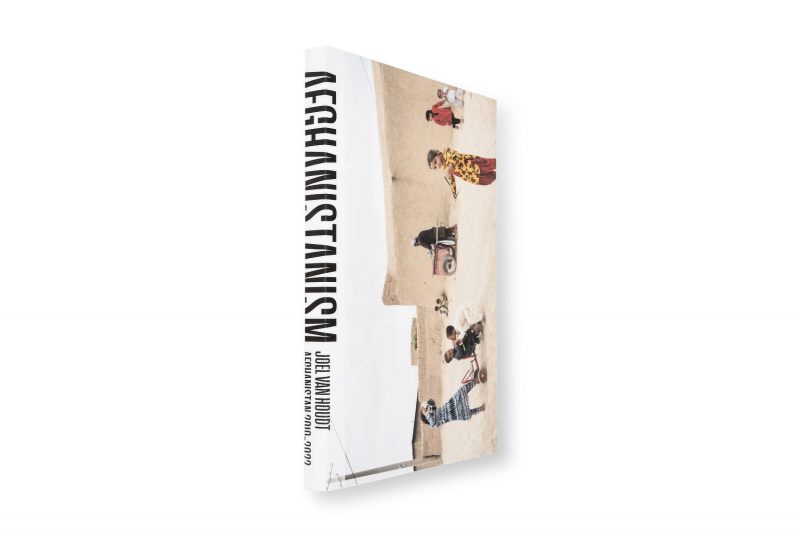
What about the country itself — Afghanistan? Joël van Houdt‘s new book Afghanistanism attempts to get closer to an answer to that question. An independent photojournalist, Van Houdt photographed the country for 12 years (for five years, he was stationed there), and the book is a distillation of his efforts.
There is much that can be said about photojournalism, and this is not necessarily the forum to do that. With its crooked horizon lines and its endless close-up depictions of yelling and/or crying people (depending on context mostly people who inevitably will be perceived as vaguely threatening for a Western audience) photojournalism keeps churning out a steady stream of visual clichés; and yet I personally still believe that it has value, in particular in the hands of practitioners like Van Houdt who attempt to avoid rehashing the same tiresome conventions in every picture.
“I was interested,” Van Houdt writes in his Postscript, “in documenting the consequences of some of the richest countries, including my own of the Netherlands, invading one of the poorest. […] Most of the photographs in the book were taken when I was not on assignment but during the thousands of hours I spent walking with no specific goal or direction in mind.”
In the Postscript, the photographer is upfront about the challenges faced by anyone doing such work. “I mostly stuck to walking in areas I deemed relatively safe,” he writes, “where I felt welcome.” And he acknowledges the difficulty of possibly getting access to the lives of women, given the complexity of the circumstances.
I personally believe that this it the right approach for a topic such as this one: There is considerable insight to be gained from it despite its limitations. A viewer looking at photographs will always have to be aware of their makers’ limitations. All photographs are the decisions of any number of decisions, which include something — and exclude a whole lot more.
When looking through the book, I was struck by the breadth of its vision. While I do look at a lot of photographs, I cannot be considered an expert on Afghanistan and how it has been depicted. Still, I find it difficult to ignore what comes across as a genuine curiosity on the photographer’s part to pierce through the veil created in part by the cliché conventions of his field.
In the end, Afghanistanism succeeds in embedding what is familiar for a Western audience with a lot more that is not (“embedding” a as word choice might seem unfortunate here, but I will stick with it).
The book comes with a large number of quotes about foreigners waging war in Afghanistan and describing what they encountered and/or thought. I’m slightly torn about the inclusion of these quotes in part because I think that the work itself (by which I mean the photographs) does not actually need it.
Of course, it is good to understand the degree with which the country has been a stage for war (and I suppose that there actually are plenty of people who don’t know this). But I do think that even without the quotes, it would become very clear to a viewer to what extent the richness of Afghanistan has been trampled on by outsiders bringing their wars there (for whatever reasons).
The book is the kind of wonderful production one by now can expect to emerge from the Netherlands, which definitely helps to communicate the photographer’s goals.
And it is now being released into a world that seems to have changed much, even if in actuality only four short years have passed since Van Houdt last went to Afghanistan. The Taliban are back in power, and countries such as Germany (one of the rich nations that sent its soldiers there) are now working with them to deport unwanted refugees (I am not making this up: “German Interior Ministry officials travelled to Afghanistan in 2025 to discuss the practicalities of deportation,” notes this article).
If anything, Afghanistanism serves as a reminder that that busy stage used for the Global War on Terror was and still is actually inhabited by ordinary people whose hopes, dreams, and aspirations are just as human as everybody else’s (their governments’ efforts notwithstanding). The often poignant photographs in the book drive this point home in a fashion that’s almost too hard to bear.
Recommended.
Afghanistanism; photographs and text by Joël van Houdt; 276 pages; self-published; 2026
If you enjoyed this article, please consider subscribing to my Patreon. There, you will find exclusive articles, videos, and audio guides about the world of the photobook and more. For those curious, there now is the possibility of a trial membership for seven days.
Much like journalism, photography criticism involves a huge investment of time and resources. When you become a subscriber, you not only get access to more of my work. You will also help me produce it (including the free content on this site).
There also is a Mailing List, which I use to send out supplementary materials — anything that has me inspired or that somehow seemed worth noting. Some of it is serious, some is not. You can sign up for free here.
Thank you for your support!