As someone who has spent a lot of time with photobooks — presenting them online, teaching how to make them, writing about them in a critical fashion, making them myself, over the years the most common question has been: what makes a good photobook? What is it that makes some books so much better than others?
Inevitably, I have struggled with providing an answer to a seemingly simple question that at its core betrays all kinds of other agendas. Mostly, though, it’s an impossible question to ask without taking into account one’s own preferences, ideas, and circumstances.
It’s a bit like asking what makes a perfect meal. Everyone could possibly name that one dish they really love; but it will still have to be made in just the right fashion and then enjoyed under just the right circumstances.
For some time, I was using a rating system for photobooks. If the world of music can live with detailed ratings, I thought, the world of the photobook can as well. Not so.
I still think that the system had considerable value, in particular since it forced me to engage with every book on as similar a footing as possible. The way the ratings were constructed, for every book I had to look at a set of details; and in almost every case, without being made to do so I might have overlooked something.
But with time I came to understand that there was still something missing, and I’ve always wondered what that missing bit might be.
I can’t say that I have the answer, yet (I probably never will). But I do think that I recently got a lot closer to understanding what makes a good photobook.
It’s character.
Character might not be the perfect word. In this particular context, it describes the overall feel I get from a book. It’s a combination of all of the various aspects that go into bookmaking.
Crucially, though, on their own these aspects are actually quite meaningless.
For example, you could only publish what you think is the best photography — and still end up with mostly not very interesting books. You could use what is widely considered the best production for a book — and still end up with mostly not very interesting books. Or you could hire the fanciest designers, chasing the latest tricks in graphic design — and still end up with mostly not very interesting books.
My inner editor tells me not to provide examples of publishers for these cases, mostly because at least to some extent, books are also a matter of taste and of understanding some of the aspects of book making (in photoland, maybe the most widely mis- and/or poorly understood aspect of book making is graphic design).
Instead, I can give you examples of publishers who in my book (pardon the pun!) nail photobook making. There is, for example, FW:Books. It’s not that I like every book they make. Many simply do not speak to me. But even the books that do not speak to me hold their own. They’re extremely well produced, and even if I don’t like the photography or idea, they make me engage with them.
Books made by FW:Books have character. Of course, it is a very specific character, and it connects with what I want to see in a photobook. Another publisher that immediately comes to my mind is Van Zoetendaal.
Lest you think it’s the Dutch bookmaking that’s responsible for this: it is not.
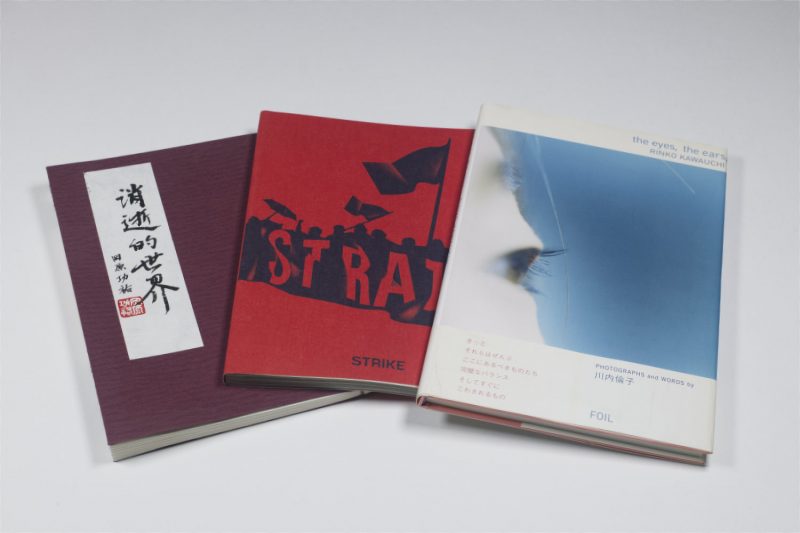
If you look at the three books I decided to feature as examples in the photograph at the top (Kosuke Okahara’s Vanishing Existence [self-published, 2013], Rafal Milach’s Strajk [Jednostka, 2021], and Rinko Kawauchi’s the eyes, the ears, [Foil, 2005]), you have three very different books that for me have enormous character even though they were made in very different fashions.
Okahara’s Vanishing Existence was hand-made. Milach’s Strajk was printed on “cheap” newsprint. Kawauchi’s the eyes, the ears, is “just” a regular mass production (it’s not even the first edition — not that this matters, given that all editions are identical).
With all of these books — and the various other books I own that I treasure so much for the same reasons — enormous character shines through, which, and this is important to me, communicates the artists’ integrity.
That’s the thing: if a book does not have much (or any) character, it’s just so much harder for the work (meaning not the photographs as individual items but the totality of the presentation) to have the integrity it might deserve.
The question of arriving at a book with character has to start with the photographer her or himself. You will have to know what you need for a book to communicate and for the package to shine — in other words for it to have character.
For you, as the reader of these words, the answer which books have the character you’re looking for might be very different than for me. And the question of character is not limited. With time, it is likely to change.
Of course, endless argument over what essentially is merely a question of taste will never end. But ultimately, they’re pointless. Someone’s favourite pizza might be someone else’s hot circle of garbage (to quote a character from the US TV show The Office).
Thus, instead of asking what makes a good photobook, you need to start out by asking what you are looking for and what you are responding to — and why. At the same time, you need to start to understand what it is in photobooks that other people respond to.
Inevitably, you will need to learn what exactly good printing is (and what is not); but you then also need to understand that fetishizing good printing does not guarantee a good book. The same is true for graphic design or whatever else.
With all of the many variables involved, it is next to impossible to say what a good photobook is. There is no formula to artistic success.
All you can do is to take books and appreciate them for what they do individually — to see whether they have character or, which is sadly much too common, whether they lack something.
It’s way past the point where writing the following will change anything. But the explosion of endless photobook “shortlists” with often dozens of entries demeans the actual experience anyone can have with photobooks. It’s neoliberalism at its absolute worst.
Instead of judging books by where they’re placed in some random list approach them to learn more about the people who made them. The good books, the ones with a lot of character, will tell you.
And that’s what makes it all worthwhile.
If you enjoyed this article, please consider subscribing to my Patreon. There, you will find exclusive articles, videos, and audio guides about the world of the photobook and more. For those curious, there now is the possibility of a trial membership for seven days.
Much like journalism, photography criticism involves a huge investment of time and resources. When you become a subscriber, you not only get access to more of my work. You will also help me produce it (including the free content on this site).
There also is a Mailing List, which I use to send out supplementary materials — anything that has me inspired or that somehow seemed worth noting. Some of it is serious, some is not. You can sign up for free here.
Thank you for your support!