In many ways, despite their background against mass carnage on enormous scales the atomic bombings of Hiroshima and Nagasaki constituted something entirely new. The earlier fire bombing of Tokyo had likely killed more people (mostly civilians the vast majority of whom burned alive). But it was Hiroshima and Nagasaki that became etched into Japan’s consciousness in ways that are almost impossible to describe.
A combination of factors might have contributed to what unfolded. To begin with, until the end of the US occupation of Japan in 1952, photographs from Hiroshima or Nagasaki could not be published (while US photographers extensively documented the aftermath in both cities — which fact we will come back to). Given the country’s history, the Japanese were used to large fires destroying their cities (often as direct consequences of major earthquakes). But two cities wiped off the face of the Earth literally in an instant?
And there were the survivors (hibakusha in Japanese), many of whom bore visible traces of what they had suffered through, and many of whom even years would die later of what initially were incomprehensible illnesses. The hibakusha largely faced incomprehension as a group, which made it very difficult for many to find life partners (there is a deeply affecting scene in Marie Mutsuki Mockett‘s Where the Dead Pause the Japanese Say Goodbye, in which a dying person reveals to their family on their deathbed that they are in fact a hibakusha).
Japanese artists have attempted to come to terms with Hiroshima and Nagasaki ever since. For example, novelist Masuji Ibuse’s Black Rain (published in 1965) centers on the attempts by a couple to find a husband for their niece, a hibakusha. The 1989 movie adaptation is as difficult to watch as the novel is difficult to read. Some of the scenes are as hard to imagine as to see, as when two young children meet in the newly burned out ruins of Hiroshima, and the older barely recognizes his brother part of whose skin is hanging loose from his limbs.
Numerous Japanese photographers have made work around the nuclear bombings. For all the right reasons, Kikuji Kawada‘s The Map has been widely lauded as arguably one of the best photobooks ever made. Unfortunately, the attention devoted to Kawada’s book has crowded out other, equally important books or works, such as, for example, Shomei Tomatsu‘s 11:02 Nagasaki or Ishiuchi Miyako‘s Hiroshima (unlike her peers, Ishiuchi has been insistent on having her name given in the Japanese order, which is why hers is the only name here following that convention). More recent approaches include, for example, Takashi Arai‘s (Exposed in a Hundred Suns).
In contrast, US photographers have not paid much attention to the devastation caused in Hiroshima and Nagasaki. This probably is in line with their country’s larger tendency to simply ignore the many “collateral” victims of its warfare (the most recent example that still haunts me are the 156 people, 120 of them schoolchildren, whose lives were cut short by cruise missiles in Minab, Iran).
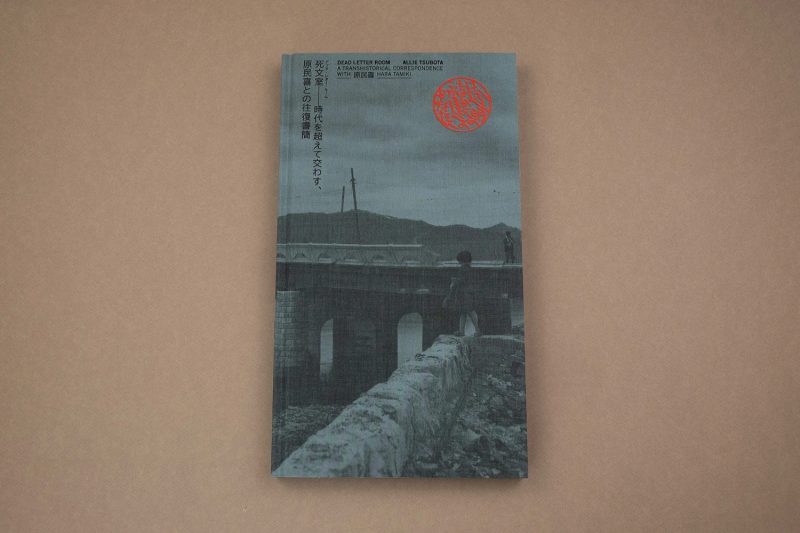
All of the above had me deeply curious about Allie Tsubota‘s Dead Letter Room. “As a fourth-generation Japanese/American,” she writes, “I am interested in histories of Asian/Pacific empire and militarization, in reciprocal desire and assimilation, and in racialized life as that which runs fragmented or fugitive across space and time.”
The book divides into three very separate parts. The first is a compilation of photographs culled from the United States Strategic Bombing Survey, which documented the outcome of the “strategic bombing” Japanese cities had been subjected to. This, of course, included Hiroshima and Nagasaki. In the book, the photographs are presented with golden ink printed on black paper.
The second part of the book, in many ways its emotional core, is an exchange of letters with writer Tamiki Hara. Hara had survived the bombing in Hiroshima and took his own life a few short years later (here is a distinct lineage of Japanese writers taking their own lives, often out of mental distress: Ryūnosuke Akutagawa, Osamu Dazai, or Yukio Mishima — all three giants of Japanese literature — come to mind).
You cannot have an exchange of letters with a dead man — unless, of course, you’re an artist, in which case you can. Printed on a thin, very fragile feeling paper, the letters manage to enter many places that the photographs are unable to reach (but then that’s the written word, isn’t it?).
Lastly, there are photographs Tsubota took in Japan, presented in the roughly second half of the book. These pictures come with selections of short texts, many of them brief explanations of what you are looking at or why you might be looking at what is depicted in them.
My own writing about photography has been driven by something I read a long time before I became a writer. “What can be said at all can be said clearly,” Ludwig Wittgenstein wrote in his Tractatus Logico-Philosophicus, “and what we cannot talk about we must pass over in silence.”
It thus might not surprise any readers to learn than in general, I am not a fan of what I call photo-academic writing, which tends to embrace the opposite approach, offering often enormous amounts of verbiage and jargon, with very little, if any, actual insight.
It’s not even the verbiage that bothers me about the two photo-academic texts Tsubota contributed to Dead Letter Room. There’s something else, a few traces, alas, pop up here and there in the letters with Hara: I found it very difficult not to imagine the writer/photographer being enormously self-conscious about the whole endeavour.
One of the books that has impressed and moved me the most over the past few years is Asal Dardan‘s Traumaland, which — unfortunately — is only available in German. Dardan was born in Teheran but grew up in (West) Germany after her parents left their native Iran. I don’t know whether the writer sees herself the same way, but Dardan essentially is German — except for all kinds of reasons, she is not. Or rather, it’s complicated (mostly for all the wrong reasons).
In Traumaland, Dardan writes about Germany’s history, in particular the many crimes committed for racist reasons. The book centers on how that history might be told — from the view point of someone who is German but whose history (if that’s the way to describe it) is not. How can that history be told? And what does it mean to be responsible?
(Given that Dardan brushes against the grain of Germans telling themselves about their present and past, potato Germans held that against her. “Occasionally,” Christoph Nick wrote, “she only sees what she wants to see and not the reality” — um, hello?)
When looking through Dead Letter Room, I had Dardan’s voice from Traumaland in my head. The circumstances, of course, are very different. And it is always unfair to compare the approaches be two different people (here even in different media) to talk about a larger issue. Still…
Alas, despite the exchange of letters with Hara, somehow Tsubota appears to have pulled back, preferring to ultimately produce a book centered on a photo-academic approach. Which, of course, is totally fine (if that is your thing).
It’s just that I do feel that there is a missed opportunity here. The risk of photo-academic writing always is that you bury people’s pain under an avalanche of verbiage and jargon — possibly your own but certainly other people’s.
The more detached verbiage you use, the easier you make it for readers to hide away whatever pangs of guilt they might feel. Then, things will not change: Seventy one years after the mass carnage in Hiroshima, then US President Barack Obama visited the city, gave one of his speeches — and left without an apology.
And so the pangs of guilt live on.
Dead Letter Room; photographs and texts by Allie Tsubota; 196 pages; The Eriskay Connection; 2026
If you enjoyed this article, please consider subscribing to my Patreon. There, you will find exclusive articles, videos, and audio guides about the world of the photobook and more. For those curious, there now is the possibility of a trial membership for seven days.
Much like journalism, photography criticism involves a huge investment of time and resources. When you become a subscriber, you not only get access to more of my work. You will also help me produce it (including the free content on this site).
There also is a Mailing List, which I use to send out supplementary materials — anything that has me inspired or that somehow seemed worth noting. Some of it is serious, some is not. You can sign up for free here.
Thank you for your support!