Influencer Creep

Article main image

It seems obvious that social media have drastically changed how photographers engage with the internet. In fact, for many people — photographers as much as the rest of the population — social media are the internet: this is where you either spend most of your time, or they provide the one jump-off point to whatever else is available online.

As a blogger, my view of social media has always been extremely critical. Early on, social media all but destroyed the very vibrant community of bloggers, pulling basically everyone into their walled gardens. Initially, I found social media off putting because they forced everyone into the same formula (this was the time when it was still very simple to customize your own blog). In addition, the people behind the new development struck me as extremely shady.

With time, I tried various social media. I left Facebook quickly because it was just too inane for me. I think I joined Instagram only after it had been bought by Facebook, meaning I did not experience its original form. Much like many (most?) other photographers, I felt compelled to have a presence there even as the site rather quickly deteriorated.

To be honest, I don’t even know how most photographers feel about Instagram. On the one hand, everybody appears to be complaining about it. On the other hand, even many of those photographers who routinely get abused by the site (for example in the various forms of censorship there) still stick around.

With the above, I don’t mean to judge anyone. I left Instagram after the founder of Facebook (now “Meta”) turned to the hard right. It’s difficult to estimate the cost of that decision (this is one of those aspects of the whole thing you keep in mind).

What I know is that contact with a lot of photographers (some of whom had told me how much they disliked the site) either disappeared or became sparse. Again, I don’t mean to imply any judgment here; still, if I’m perfectly honest I need to state that I am not sure this trend has sat well with me.

As I just noted, the true cost of being on Instagram is hard to assess — and the same is true for the benefit. From what I can tell, a lot of photographers have a presence on Instagram because they feel that they cannot risk not using this way of showcasing their work and ideas.

Costs and benefits might come in all kinds of forms, and I want to invite people to think about them more broadly: the time spent scrolling through your feed — that’s a cost; the anxiety induced by wondering why your posts don’t get seen or don’t invite many interactions or whether you’ve been shadow-banned — that’s a cost; the thinking about what to showcase and how to do it — that’s a cost.

In other words, by design social media make it extremely difficult to assess their actual value while accumulating all kinds of costs (regardless of whether someone is aware of the cost or not: often, it’s very difficult to notice how one’s mental health, for example, is slowly getting worse).

One of the challenges of social media is that — again, by design — they make it extremely difficult to at least somewhat objectively assess what’s going on. The reality is that collectively at least in theory we could have much better discussions of the value of social media for photography/photographers if we had access to trustworthy information about it.

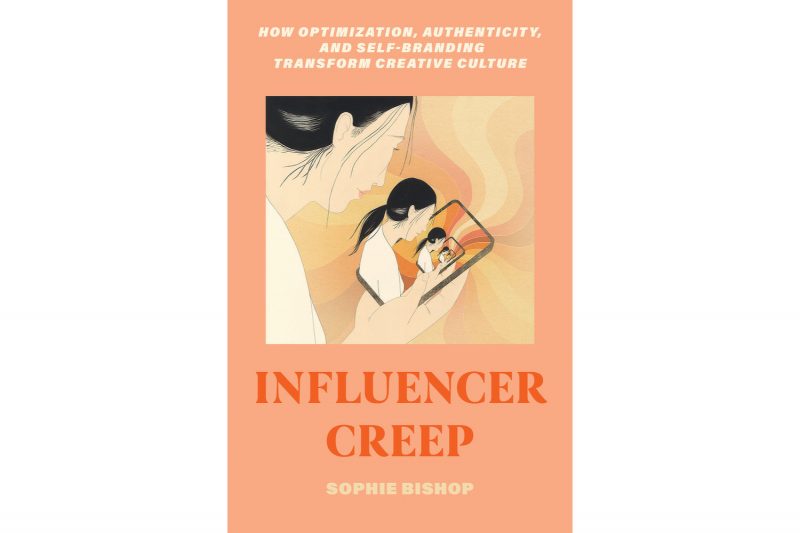
The good news is that such information has now become available in the form of Sophie Bishop‘s book Influencer Creep. Bishop is an Associate Professor in Media and Communications at the University of Leeds who focuses on social media, algorithms, and influencer culture. If anyone might have the answers a lot of people are looking for it’s this scientist.

Of course, influencers have a very bad reputation in the world of photography (and beyond). Why would you read a book about influencers if you’re a photographer?

To begin with, the book is not about influencers. More accurately, it focuses on how understanding how influencers operate (which here mostly means: have to operate) helps understanding how this kind of thinking and work has now slowly but steadily infiltrated how artists operate on social media.

“A study of influencer creep,” Bishop writes, “means an examination of the additional layers of inequality that influencer culture brings to this highly  unequal workplace” — “this highly unequal workplace” being what people otherwise refer to as, say, the world of art (of which photoland is a part). “I’ve found that, because they experience platformized work first, influencers foreshadow contemporary working conditions in art worlds, a field of apparent independence that is ostensibly located at one of the furthest distances from influencer culture.” (p. 206 f.)

“Instead of reifying divisions,” Bishop declares right before the conclusion of her book, “this book on influencer creep is a rallying cry for a common cause and an invitation to account for the many ways that social media platforms, together with the cultural expectations brought by influencer creep, may harm individuals by reducing workplace protections through the increase in demands for entrepreneurs to create content and put themselves online, by eroding an ability to take sick leave or parental leave under threat of algorithmic invisibility, and through the threat of losing access to audiences, without explanation or recourse, that an individual has labored intensely to build.” (p. 191 f.)

While I am personally under no illusion that we will actually see more photographers move towards a common cause (for better or worse, photographers appear to be highly individualistic), becoming more aware of how social media operate and how one might find one’s right spot in it is obviously very important.

Influencer Creep is extremely revelatory in any number of ways. For example, Bishop dives deeply into what algorithms actually do, how they are set up to function, and what might be gained from attempting to understand them. Or there is a chapter on what it might mean to be authentic online — or rather what it might mean for the material (“content”) one decides to create for online use to come across as authentic.

The book is very clear eyed about the different challenges faced by different people, challenges that actually are not at all limited to social media but that reflect the larger environment artists operate in: “Women and nonbinary artists’ behavior,” Bishop writes, “never actually brings about the professional, critical, or economic rewards that it does for men.” (p. 172)

Influencer Creep offers a number of case studies, artists from all kinds of practices. My suspicion is that things are a bit worse in the world of photography, given how extremely conservative (if not often outright reactionary) it is. Whether that might be the case or not, I do think that it helps to learn about the challenges someone faces whose art work involves metal or cloth. Sometimes, it’s easier to see what’s going on in one’s own environment by looking at something that at least on the surface appears to be very different.

Despite Bishop’s call to arms (quoted above), I think the main or maybe the important initial value of the book for photographers will be to see how what they experience isn’t any different than what all of the other artists have to deal with.

Furthermore, making fun of influencers might be easy (to me, expressions of disdain for influencers has always been tinged with way too much elitism); but suddenly finding out that in any number of ways any photographer has to deal with a lot of the same challenges is, well, sobering.

Given how opaque the world of social media is that has been set up by the hard-right tech bros who run them, Influencer Creep provides ample insight for any photographer to arrive at a better place when thinking about whether and/or how to use social media.

To make better decisions you need to be armed with better information. That’s what it comes down to.

Of course, in the end there will never be that perfect answer for what to do with or for social media. Every photographer will have to decide that for her or himself. But being able to navigate that world knowing more about what is going on can only help.

Highly recommended.

Sophie Bishop: Influencer Creep — How Optimization, Authenticity, and Self-Branding Transform Creative Culture; 280 pages; University of California Press; 2025

If you enjoyed this article, please consider subscribing to my Patreon. There, you will find exclusive articles, videos, and audio guides about the world of the photobook and more. For those curious, there now is the possibility of a trial membership for seven days.

Much like journalism, photography criticism involves a huge investment of time and resources. When you become a subscriber, you not only get access to more of my work. You will also help me produce it (including the free content on this site).

There also is a Mailing List, which I use to send out supplementary materials — anything that has me inspired or that somehow seemed worth noting. Some of it is serious, some is not. You can sign up for free here.

Thank you for your support!
Sisters, Saints and Sibyls

Article main image

Art has mostly no power except for the following: it can remind us that at least in theory we have the option to become better people than who we are. By “better people” I don’t mean more productive or more popular or more powerful. Instead, “better” orients itself by the ideals we hold dear deep down inside us (regardless of to what extent we might have repressed our awareness of them).

Typically, better involves more: more forgiving, more loving, more accepting (these latter two aren’t the same even though there certainly is some overlap), more willing to see past someone else’s faults, more of a capacity to see the other person exactly for who they are.

The more an artist is willing and able to pursue that route, the stronger their work becomes — and the stronger resistance either against the work or the person (or both) becomes.

In this golden age of utility in which a person is measured solely by what they can do to help the rich become even more rich, nobody poses more of a threat than the artist who simply by insisting on seeing the humanity of the other points out the insanity of seeing people as means for an end.

It is easy to understand how Nan Goldin and her work exemplify the very best of the above. The fact that so many aspects of the work appear to be so timeless is not only rooted in them remaining unresolved. I would argue that the timelessness is buoyed by the photographer’s integrity and compassion (a compassion that, and therein lies a drama that is not too uncommon, she often appears to not have been able to extend towards herself).

All of Goldin’s work is an expression of love: for those in front of her camera, regardless of who were were or are and regardless of whether or not they reciprocated it.

Of course, there are many types of love, and they all make an appearance. There’s the familial one (the first one we all get to experience [even if just through its absence]), there’s the sexual one (that often positions itself in confrontation to other forms of love), etc.

The collection of photographs that became known as The Ballad of Sexual Dependency centers on all of those expressions of love. Tellingly, it has lost none of its relevance or potency even if a surface read would place it into the 1980s (when the photographs were taken). In fact, it would be straightforward an exercise to demonstrate how many aspects have become even more relevant today, given societal and political developments.

But art is not a competition, and it can only be lessened by trying to squeeze it into fixed categories that conform to narrow ideas. I maintain that the fact that Ballad still feels so relevant and powerful today is because it was driven by that seemingly radical form of acceptance for other people — those in front of the camera.

“I see you, I love you, and that’s why you are very much worthy of being the subject of a radiant photograph” — ultimately that is the most wonderful compliment a photographer can give.

Given who and what was depicted in Ballad, the work has been seen as activist, regardless of whether the focus was put on sexual mores, on domestic abuse and/or violence, or on the full, wide spectrum of human sexuality and gender.

To call an artist an activist can easily become a double edged sword, and often that’s the idea. In certain quarters, to call an artist an activist is an attempt to lessen them. Activism, after all, is much more bound to the daily grind of human life than art. Everybody can be an activist — even the most hack journalist who needs a quick tool to denigrate an artist’s work.

In contrast, few people are able to rise to the level of artistry that Nan Goldin has demonstrated over the course of the past few decades.

Of course, there is an element of activism to all art, an attempt to if not change someone’s mind then at least to have them engage more fully with some of the hidden potential inside them.

It is telling that some of the people who have embraced living their principles in what they do are labeled activists as a first step, to then smear them and take them down.

It is no coincidence that recently both Ms Rachel and Nan Goldin have attracted such hostility for simply applying what they deeply believe in. It’s straightforward to see how limitless compassion could be seen as tarnishing those who for whatever reason are unwilling and/or incapable of exercising it themselves.

I believe that something has seriously gone off the rails when hugging and/or speaking up for all children, regardless of where they are from, or mourning the victims of a genocide are seen as expressions of some evil activism.

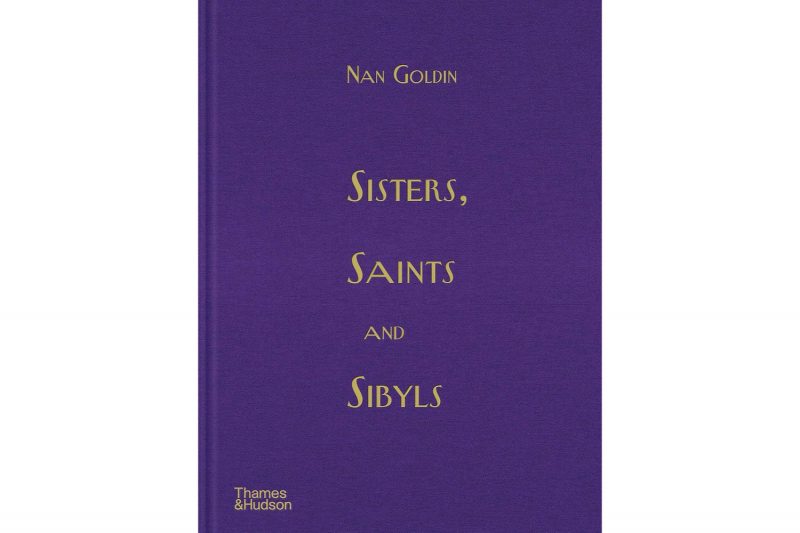
In a recent reissue of a book entitled Sisters, Saints and Sibyls, Nan Goldin traces back her life and career. Originally published in 2004 in France, the book essentially is a visual autobiography with a huge focus on Barbara, the photographer’s older sister who took her own life.

“My sister told me her psychiatrist said I would end up like her,” Goldin writes (p. 76).

“At 14, I left home.” (p. 78)

“At 18 I started to shoot dope, and shoot pictures. That saved my life.” (p.82)

When thinking about photography projects, I often consider what the work started out from and what it might be about. Those two often overlap, but, crucially, they’re not identical.

Applying similar thinking to the photographer’s life  probably is a good idea. This is not to deny the reality of everything laid out in the book. Ultimately, every person’s life and art are complex. Convenient explanations are mostly just that, convenient; often, they’re a first step to applying simple labels.

Nobody familiar with The Ballad of Sexual Dependency will be surprised by the openness and unflinching honesty of Sisters, Saints and Sibyls. Still, I do think that especially those looking for quick access to the former book might be deceived by the latter.

The openness and unflinching honesty are part of what makes Ballad so great. Many other books in the history of photography are open and unflinchingly honest; and yet so few reach its ethereal quality. This is because of the love driving the photographs, a form of love that is largely absent in vast parts of the medium’s history.

How to express or apply that love cannot be communicated. It can only be lived. Nan Goldin shows us how to do it in her own life and work. How exactly to do it in our own lives (or art) is something we have to figure out ourselves.

Sisters, Saints and Sibyls; photographs and text by Nan Goldin; 144 pages; Thames & Hudson; 2026

If you enjoyed this article, please consider subscribing to my Patreon. There, you will find exclusive articles, videos, and audio guides about the world of the photobook and more. For those curious, there now is the possibility of a trial membership for seven days.

Much like journalism, photography criticism involves a huge investment of time and resources. When you become a subscriber, you not only get access to more of my work. You will also help me produce it (including the free content on this site).

There also is a Mailing List, which I use to send out supplementary materials — anything that has me inspired or that somehow seemed worth noting. Some of it is serious, some is not. You can sign up for free here.

Thank you for your support!