Art has mostly no power except for the following: it can remind us that at least in theory we have the option to become better people than who we are. By “better people” I don’t mean more productive or more popular or more powerful. Instead, “better” orients itself by the ideals we hold dear deep down inside us (regardless of to what extent we might have repressed our awareness of them).
Typically, better involves more: more forgiving, more loving, more accepting (these latter two aren’t the same even though there certainly is some overlap), more willing to see past someone else’s faults, more of a capacity to see the other person exactly for who they are.
The more an artist is willing and able to pursue that route, the stronger their work becomes — and the stronger resistance either against the work or the person (or both) becomes.
In this golden age of utility in which a person is measured solely by what they can do to help the rich become even more rich, nobody poses more of a threat than the artist who simply by insisting on seeing the humanity of the other points out the insanity of seeing people as means for an end.
It is easy to understand how Nan Goldin and her work exemplify the very best of the above. The fact that so many aspects of the work appear to be so timeless is not only rooted in them remaining unresolved. I would argue that the timelessness is buoyed by the photographer’s integrity and compassion (a compassion that, and therein lies a drama that is not too uncommon, she often appears to not have been able to extend towards herself).
All of Goldin’s work is an expression of love: for those in front of her camera, regardless of who were were or are and regardless of whether or not they reciprocated it.
Of course, there are many types of love, and they all make an appearance. There’s the familial one (the first one we all get to experience [even if just through its absence]), there’s the sexual one (that often positions itself in confrontation to other forms of love), etc.
The collection of photographs that became known as The Ballad of Sexual Dependency centers on all of those expressions of love. Tellingly, it has lost none of its relevance or potency even if a surface read would place it into the 1980s (when the photographs were taken). In fact, it would be straightforward an exercise to demonstrate how many aspects have become even more relevant today, given societal and political developments.
But art is not a competition, and it can only be lessened by trying to squeeze it into fixed categories that conform to narrow ideas. I maintain that the fact that Ballad still feels so relevant and powerful today is because it was driven by that seemingly radical form of acceptance for other people — those in front of the camera.
“I see you, I love you, and that’s why you are very much worthy of being the subject of a radiant photograph” — ultimately that is the most wonderful compliment a photographer can give.
Given who and what was depicted in Ballad, the work has been seen as activist, regardless of whether the focus was put on sexual mores, on domestic abuse and/or violence, or on the full, wide spectrum of human sexuality and gender.
To call an artist an activist can easily become a double edged sword, and often that’s the idea. In certain quarters, to call an artist an activist is an attempt to lessen them. Activism, after all, is much more bound to the daily grind of human life than art. Everybody can be an activist — even the most hack journalist who needs a quick tool to denigrate an artist’s work.
In contrast, few people are able to rise to the level of artistry that Nan Goldin has demonstrated over the course of the past few decades.
Of course, there is an element of activism to all art, an attempt to if not change someone’s mind then at least to have them engage more fully with some of the hidden potential inside them.
It is telling that some of the people who have embraced living their principles in what they do are labeled activists as a first step, to then smear them and take them down.
It is no coincidence that recently both Ms Rachel and Nan Goldin have attracted such hostility for simply applying what they deeply believe in. It’s straightforward to see how limitless compassion could be seen as tarnishing those who for whatever reason are unwilling and/or incapable of exercising it themselves.
I believe that something has seriously gone off the rails when hugging and/or speaking up for all children, regardless of where they are from, or mourning the victims of a genocide are seen as expressions of some evil activism.
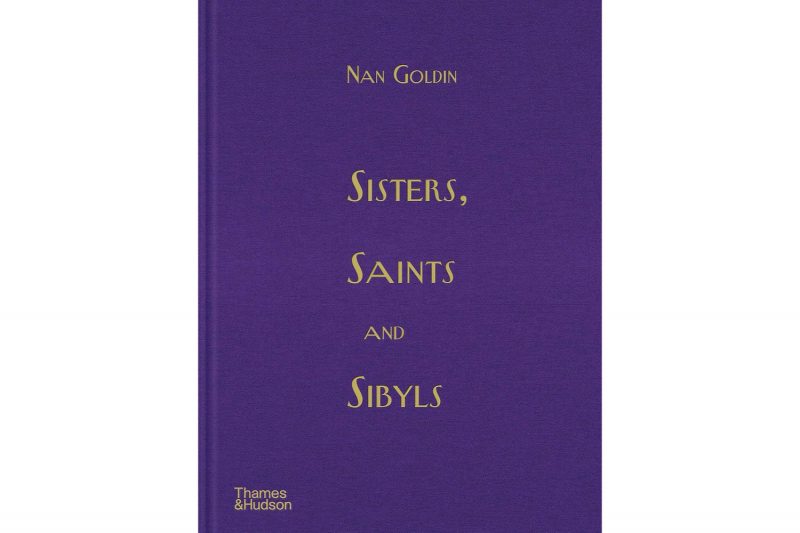
In a recent reissue of a book entitled Sisters, Saints and Sibyls, Nan Goldin traces back her life and career. Originally published in 2004 in France, the book essentially is a visual autobiography with a huge focus on Barbara, the photographer’s older sister who took her own life.
“My sister told me her psychiatrist said I would end up like her,” Goldin writes (p. 76).
“At 14, I left home.” (p. 78)
“At 18 I started to shoot dope, and shoot pictures. That saved my life.” (p.82)
When thinking about photography projects, I often consider what the work started out from and what it might be about. Those two often overlap, but, crucially, they’re not identical.
Applying similar thinking to the photographer’s life probably is a good idea. This is not to deny the reality of everything laid out in the book. Ultimately, every person’s life and art are complex. Convenient explanations are mostly just that, convenient; often, they’re a first step to applying simple labels.
Nobody familiar with The Ballad of Sexual Dependency will be surprised by the openness and unflinching honesty of Sisters, Saints and Sibyls. Still, I do think that especially those looking for quick access to the former book might be deceived by the latter.
The openness and unflinching honesty are part of what makes Ballad so great. Many other books in the history of photography are open and unflinchingly honest; and yet so few reach its ethereal quality. This is because of the love driving the photographs, a form of love that is largely absent in vast parts of the medium’s history.
How to express or apply that love cannot be communicated. It can only be lived. Nan Goldin shows us how to do it in her own life and work. How exactly to do it in our own lives (or art) is something we have to figure out ourselves.
Sisters, Saints and Sibyls; photographs and text by Nan Goldin; 144 pages; Thames & Hudson; 2026
If you enjoyed this article, please consider subscribing to my Patreon. There, you will find exclusive articles, videos, and audio guides about the world of the photobook and more. For those curious, there now is the possibility of a trial membership for seven days.
Much like journalism, photography criticism involves a huge investment of time and resources. When you become a subscriber, you not only get access to more of my work. You will also help me produce it (including the free content on this site).
There also is a Mailing List, which I use to send out supplementary materials — anything that has me inspired or that somehow seemed worth noting. Some of it is serious, some is not. You can sign up for free here.
Thank you for your support!