We see in photographs what we want to see instead of what is depicted. This basic fact constitutes the core of why and how photography provides such a useful service for our capitalist world.
In fact, the medium has played such an integral role for modern capitalism that it’s nearly impossible to disentangle the two. In its most perverse incarnation, the one I call neoliberal realism, photography ends up serving as little more than a lickspittle, a fawning propaganda tool (even if the photographers’ original intent might in fact have been something else entirely).
Consequently, photography done with the express interest of what we might consider as a critique of consumerism will find that that role ultimately cannot be fulfilled. This is not necessarily because capitalism is beyond critique (even though the world of art photography is so enmeshed with the interests of wealthy people that what counts as critique often only is a form of window dressing for capitalist exploitation). Instead, it is because of the roles photography and capitalism play in our daily lives.
In a nutshell, capitalism, in particular the turbocharged neoliberal kind we have had to live under for decades now, relies on images. Photographs constitute not only some of the images used by capitalism, photographs also guide how we think of our own position in an image-centric world.
It would certainly be wrong to claim that there exists no visual literacy; we are, in fact, literate enough to question the truthfulness of some of the imagery we encounter. But the prevalent amount of visual literacy at people’s disposal does not suffice to break the stranglehold held by images in the service of capitalism.
In addition, capitalism has always been very adapt at taking in and using any form of imagery that at least initially appeared to offer a new, different way of looking at the world. In part, this is because capitalism thrives when it can project an image of newness. Nobody needs to replace something that is not broken and that does not need a replacement. The moment there is a new, “improved” version, though, the equation changes considerably.
Adopting and adapting new imagery has been a staple of the capitalist enterprise. Where needed, existing rawness will mostly be polished away: the idea is to offend a consumer’s sensibility just enough that they will be pushed out of their comfort zone — without becoming too uncomfortable.
Leaving some rawness in serves as a knowing wink towards the target audience: see, you are smart enough to see what you see, so (using Elizabeth Holmes’ words in what by now has become a meme) why would I deceive you? Occasionally, outright provocation does work as well, especially since it is mostly used sparingly and only by the typically limited numbers of people commonly described as “enfants terribles” (but it can only be occasionally, lest the underlying “bad boy” idea wears off).
Mostly, though, capitalism does not have to do any extra work. One the most poorly understood aspects of art photography is that many of its images can serve as neoliberal realism without the need for any changes. Artists such as Andreas Gursky have built lucrative careers creating such photographs: the difference between what is expected from them in the context of art and how they might function in the context of capitalism is non-existing. If you were to draw a Venn diagram, you’d get a perfect circle.
This basic fact is a hard pill to swallow for the denizens of the world of art photography, in particular given one of its foundational pillars is an insistence in having at least some sort of distance from the world depicted in their images. For neoliberal realism, there is no such distance.
That said, one needs to be careful when trying to understand the implications of what I pointed out. To repeat it, Andreas Gursky’s photographs are not only propaganda for our capitalist world. They can simultaneously be read and/or interpreted as art. It’s the equivalent of the duck-rabbit illusion.
Of course, not all art photography is neoliberal realism — that’s not the issue. The issue is also not whether or not artists such as Gursky intend to produce neoliberal realism. The reason why it is so difficult for many people to understand the issue at hand is a symptom of the rather impoverished state of photography criticism, which contains neither the vocabulary nor the discourse to separate art photography from neoliberal realism.
As a consequence, many artists are incapable of understanding how their work can serve as neoliberal realism or how to avoid falling into the duck-rabbit illusion trap.
In a nutshell, our neoliberal world is designed to be seen. It presents itself in a very particular fashion, projecting ideas of awe and superb power: think of it as the neoliberal sublime. But you will have to understand that this form of the sublime operates a little bit differently than others. It’s a cultural, secondary sublime, one that depends very strongly on its viewers having a very specific mindset.
Even though many expressions of the neoliberal sublime appear to be tacky or gaudy or appear to point to an impoverished sense of taste, many of the discussions around “kitsch” or “camp” have long blunted the impact of calling attention to the tackiness of something.
Elon Musk’s cybertruck, for example, is an extremely tacky object. But the tackiness does not provide a useful basis for critique. To begin with, one needs to be careful not to revert to old-fashioned aesthetic elitism to critique the object. Instead, the cybertruck needs to be understood not in aesthetic terms but as a code (see my discussion of codes in the context of neoliberal realism).
In other words, in order for critique of our neoliberal world to function, it has to address the codes — instead of the visual expressions themselves. The codes are the only area where clearly many targets of critique can be found.
Beyond the cybertruck, this approach extends to all visual expressions of neoliberal capitalism, including photography. Photography that expressly replicates some of the tackiness displayed by neoliberal capitalism almost by definition collapses into an expression of capitalist desires regardless of whether that collapse is intended by the person behind the camera or not.
That’s why so much of contemporary art photography that purports to express a criticism of our contemporary world in the end fails to do that: replicating something that is designed to be seen will not produce the kind of opening a viewer needs to understand the many frictions that still underlie capitalism but that now have become buried underneath an avalanche of visual tackiness.
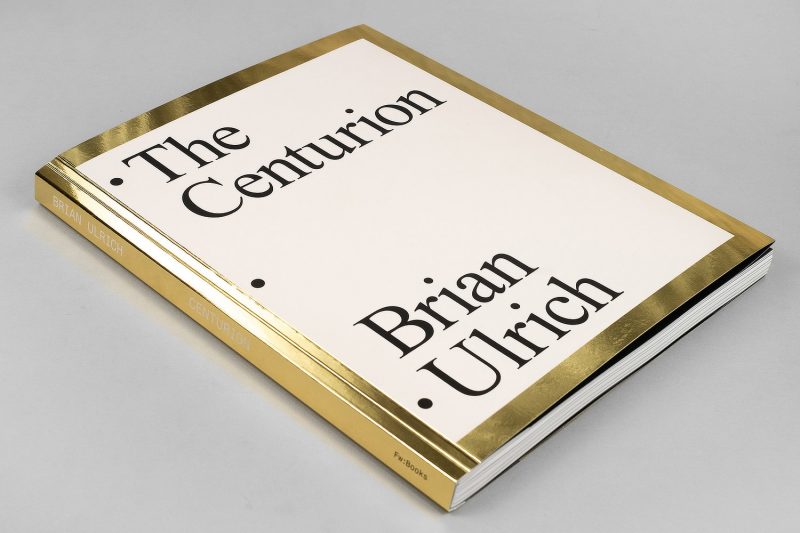
“Photography has a particular power to reveal what many are blind to, especially within the culture of privilege,” part of the statement for Brian Ulrich‘s new book states, “The Centurion shows how commerce and consumption fuel irrational desire, envy, and the pursuit of power, while also revealing the often frail mechanics of its construction, evident in the inherent loss of value of an expired credit card or the folly of a contemporary home built as architecture of defense.”
The book presents a series of photographs around forms of luxury consumption made by Ulrich over the course of a decade. It presents the images using a system of chapters. Each chapter is prefaced by what looks like the cover sheet of some corporate report, followed by the reproduction of a credit card (the cards’ designs indicate that they were issued decades before the ones in our own wallets). The photographs were taken across the United States.
I would consider the statement to be aspirational more than an actual description of what is included in the book, the reason being what I laid out in the lengthy introduction above. Many (most?) of Ulrich’s photographs in the book simply cannot fulfill their desired function (showing “how commerce and consumption fuel irrational desire, envy, and the pursuit of power”). Or rather, they show it if you want to see that in them.
But you could also simply see an expression of the kind of hyperconsumerist world that we have come to inhabit (I might as well point out that I am writing these words two days after the official start of the most consumerist period in the United States, the so-called “holiday season”).
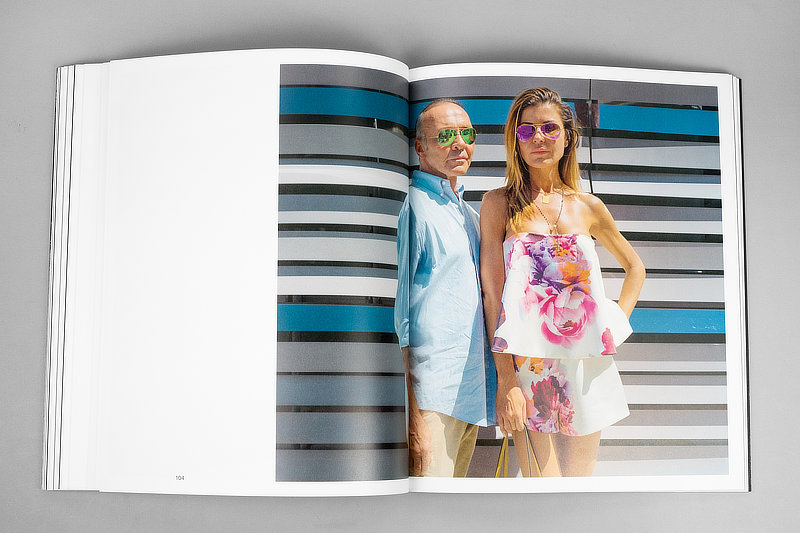
Ricardo and Jeanne, for example, photographed in Beverly Hills while being out and about (p. 104f.), might not see anything wrong with how they appear in their portrait — and why would they? In what way would their portrait make a viewer think about “how commerce and consumption fuel irrational desire, envy, and the pursuit of power”? In what way would they think about that?
I’m sure the readers of this website would mostly agree on how irrational desire is bad, and so are envy and the pursuit of power. The problem is that this does not form the basis from which art can arise: if you already know beforehand what you want to get out of your art, then you’re not actually making any.
Or rather, if your idea of art is some form of agitprop, that’s fine. But then the art needs to be explicit about what it is doing, such as, for example, Barbara Kruger’s Your Body Is A Battleground.
Taken into today’s hypercapitalist world, though, I don’t think Kruger’s approach has the quite the same potency any longer. Remember, we’re in Elizabeth Holmes meme territory now, a world in which it takes a meta-documentary to attempt to rupture both the way capitalism has commodified all known forms of dissent and the way the general idea of truth has largely become eroded.
This is not to say that The Centurion is agitprop. That’s not a read I would put on the book. My main point is that the book does not appear to be fully cognizant of where we already are in terms of how we navigate the capitalist world around us. The book also does not fully understand how depicting capitalist expressions runs the risk of merely replicating them.
And there’s another problem: Depictions of seemingly wealthy consumers can be just as othering as those of, say, the underprivileged people Richard Avedon took in the American West. Sure, you can talk yourself into believing that the subjects’ privilege blunts the effect. To some extent, I’m with you on that. But othering remains othering.
I’m not learning anything when I’m made to stare at other people, regardless of how much money they have. At worst, I can be seduced into projecting expressions of “irrational desire, envy, and the pursuit of power” onto them, feelings that, of course, I don’t have to deal with at all in my own personal life. Irrational desire? Moi?
At the end of the day, a critique of commerce and consumption is incredibly difficult to do, given how enmeshed we all are in the system and given the many strategies we already employ in our daily lives to try not to be too effected by it. The simple reality is that regardless of how avid a consumer you are, you are a consumer. And there are no hard boundaries.
For me, all of which means now, after having looked at photography for a long time and after having spent years thinking about it, that on its own the medium simply is no tool that’s sufficient to create a meaningful critique of consumerism and, by extension, capitalism (Allan Sekula already knew this when he made Fish Story, which largely relies on text).
In part, the problem stems from the fact that having had to live in a thoroughly capitalist world we all have become fully aware of the fact that the moment we see a picture, we ask ourselves what someone wants from us. The photographer’s task is to make their viewers disengage from that mechanism; but with a subject matter around consumerism, that’s simply an almost impossible task.
The Centurion; photographs by Brian Ulrich; 164 pages; FW:Books; 2026
If you enjoyed this article, please consider subscribing to my Patreon. There, you will find exclusive articles, videos, and audio guides about the world of the photobook and more. For those curious, there now is the possibility of a trial membership for seven days.
Much like journalism, photography criticism involves a huge investment of time and resources. When you become a subscriber, you not only get access to more of my work. You will also help me produce it (including the free content on this site).
There also is a Mailing List, which I use to send out supplementary materials — anything that has me inspired or that somehow seemed worth noting. Some of it is serious, some is not. You can sign up for free here.
Thank you for your support!