“When the great etch-a-sketch is shaken”, Gregor Hens writes in The City and the World, “and the public streets are erased, this microcosm always remains, the memory of the most familiar paths, of the sun falling at a certain angle on the breakfast table, of a window reflected in a window. Carpet bombing doesn’t destroy the experience of the city, its grid or aspect, because it’s within us.” (p. 205, emphasis in the original)
Carpet bombing does not, and neither does a nuclear bomb, nor however one would describe the obliteration of Gaza, an accumulation of presumed precision strikes that through their indiscriminate application is all but indistinguishable from carpet or nuclear bombing.
The closest historical equivalence for Gaza I can think of is the systematic destruction of Warsaw during World War 2 by the German military, which description might get me in trouble with the Germans who, in the name of not forgetting the lessons learned from their past, with the insistence that their crimes surely cannot compared to other people’s are doing exactly that: forgetting the lessons learned from their past (assuming that any lessons were actually learned, an increasingly uncertain idea).
In any case, however one wants to describe how a city is destroyed is not visible from what that city looks like afterwards: a jumble of rubble, stretching as far as the eye can see, with outlines of mostly major roads and the few surviving structures providing points from which to possibly find one’s bearings. The city is gone, and those who somehow survived its destruction and possibly the various later afflictions that might hit them (unexploded bombs, radiation poisoning, or other health problems) find themselves tasked with rebuilding.
In the popular imagination, both in Japan and outside of the country, the destruction of Hiroshima and Nagasaki has played a particular role. That destruction initiated the so-called nuclear age, the age whose crowning achievement it has been (if that’s even a way to describe this) that all of humanity can now be destroyed in a large enough nuclear war.
Thus Hiroshima (to a lesser extent Nagasaki, much like a younger sibling will always get less attention than the oldest one) not only rose from its ashes but became a symbol in a way that Warsaw did not. Consecutive Japanese governments contributed to the symbolism by leaving what had been the Hiroshima Prefectural Industrial Promotion Hall as it had been found after the bombing. “It is permanently kept in a state of preserved ruin,” Wikipedia states, “as a reminder of the destructive effects of nuclear warfare.”
Across the river from what now is commonly called the Atomic Bomb Dome (officially Hiroshima Peace Memorial), there is the Hiroshima Peace Memorial Park that every year holds a large ceremony to honour the memory of those who lost their lives on that August morning in 1945.
But life has also largely continued in Hiroshima, as it has in all of the locales destroyed by modern warfare I can think of. Today, more than eight decades after its destruction, the city has over one million inhabitants, and it is known not only for its nuclear past but also for, say, its okonomiyaki (think of it as some sort of elaborate Japanese pancake), its baseball team (Hiroshima Toyo Carp), or as the hometown of Suzuka Nakamoto, a member of Babymetal.
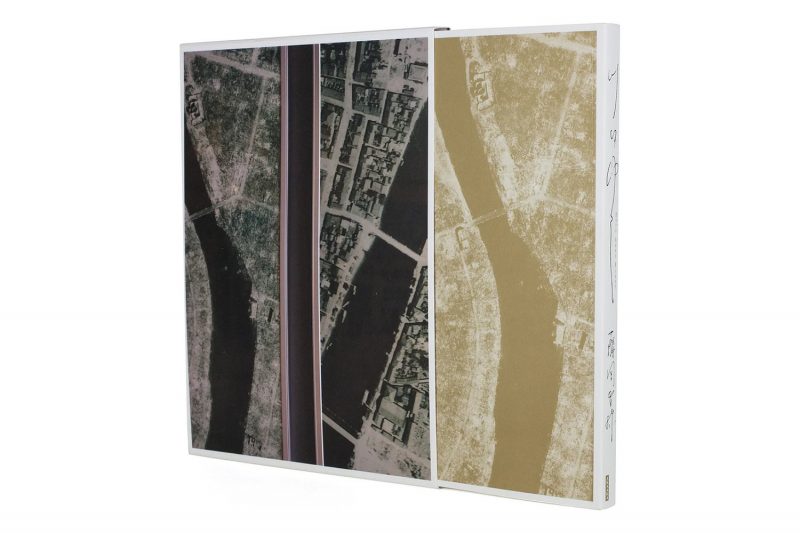
In Aya Fujioka‘s 川はゆく (English title Here Goes River; originally published in 2017, a second edition came out in 2025), all of the above and more weave through the photographer’s pictures, taken in and around Hiroshima.
As far as I can tell, the publisher’s description of her “snapshot approach” makes sense in Japan where this wording carries slightly different connotations than in the West. Here, snapshots are often seen as something done out of a lack of consideration or as some sort of throw-away approach.
But that’s not how the term is used in Japan; for sure, that’s not the spirit of the work. Fujioka walked around the city and took photographs of things or people that caught her attention. There also is the occasional portrait that, one might assume, must have involved asking the sitter for permission.
There is an incredibly looseness around the photographs, which serves the work well (it might have been tempting to cover a weighty topic with equally weighty pictures). It also allows the artist to sneak in an overall complexity into the work that its visual language might belie (at least at a first, possibly somewhat superficial, exposure).
As a viewer, I often have trouble with photography that uses this approach because the risk that the pictures will in fact end up being merely throw-away photographs is considerable. The moment you fall into that trap as a photographer, the work doesn’t add up to much — well, in my book anyway (as always, your mileage might vary).
When I look at photographs, I personally want to see the urgency with which someone took them conveyed — urgency here not arising from a lack of time or from a deadline. Instead, the urgency stems from the feeling that if the work does not live up to what its maker needs it to be, then that would be too colossal an artistic failure to bear.
And that’s what pervades this work for me, that urgency, an urgency that ties the sheer horror of the destruction of a whole city with the mundane beauty that sprang up in its place.
Comparisons are always the pest, in particular since we live in a time where they have been broadly misused for nefarious purposes in a fashion that often does not allow us to sit with possible complexities. Still, while 川はゆく is very different than Kikuji Kawada‘s famed The Map (a few years ago, I wrote a piece about it that I think still holds up well), if you manage to ignore the obvious photographic differences (Kawada’s stark black and white versus Fujioka’s light colour etc.) you will find two books that employ some of the same visual strategies.
In contrast to Kawada, though, Aya Fujioka ends up embracing a much more tender approach. While there are frequent depictions of the horror of that day in August 1945 (or allusions to them in all kinds of ways), there also is simple life as it goes on. There is, after all, the difference in time — and generation: Kawada barely avoided getting drafted into the war, while Fujioka was born two generations later.
We need to remember as much as we need to forget. While we need to remember the horrors of the past, we must not insist in the supremacy of those horrors. What I mean by that is that we must not allow ourselves to fall into that trap of self-righteousness that the Germans now inflict upon themselves: accepting today’s life and suffering does not mean that somehow, the suffering of the past is pushed aside.
In the end, life always springs from the ashes, wherever those ashes might be; and we can only take care of those who somehow managed to find themselves in those ashes.
That is our duty: not to forget so that we might help them live (and not to remember so that we can heartlessly celebrate our own remembering — as if we somehow were engaged in an elaborate contemporary kabuki play); not to forget so that we might become better people who will do their utmost to prevent the production of further ashes.
Maybe the most important photograph in 川はゆく is one of a baby. There first is a landscape above which the sky is bright yellow-orange, as if on fire. Then, there is a photograph of a flame, seen as if emerging from the woods (or maybe park). And then there is that baby, happily asleep in their mothers arm, and the bright sunlight filtering in from the right is completely blown out.
In Kawada’s book, that light would stand for the explosion of the bomb. Here, the light can be read as an allusion to the bomb; but it can also be read as the bright light from which all life might emerge. If as a viewer, you allow for the possibility of both interpretations to exist at the same time, you’re in business.
Highly recommended.
川はゆく(Here Goes River); photographs by Aya Fujioka; 240 pages; Akaaka; 2017 (first edition; second edition: 2025)
If you enjoyed this article, please consider subscribing to my Patreon. There, you will find exclusive articles, videos, and audio guides about the world of the photobook and more. For those curious, there now is the possibility of a trial membership for seven days.
Much like journalism, photography criticism involves a huge investment of time and resources. When you become a subscriber, you not only get access to more of my work. You will also help me produce it (including the free content on this site).
There also is a Mailing List, which I use to send out supplementary materials — anything that has me inspired or that somehow seemed worth noting. Some of it is serious, some is not. You can sign up for free here.
Thank you for your support!