A few years ago, Karin Wieland wrote a double biography of Marlene Dietrich and Leni Riefenstahl, two German women whose career ran in parallel and who made very different choices when faced with the rise of the Nazis. Dietrich ended up cheering on the Allied soldiers who had to invade Western Europe to rid it off the Nazi pest that Riefenstahl had so prominently promoted.
It’s possible that the two women met during the ill-fated Weimar Republic. But their lives mostly ran in parallel. And in each section of the book, the reader always has the other person in mind; the other person and her choices. It’s an extremely nifty device to not only bring forth the careers of two women artists living in a world in which the focus was on men; the device also serves to amplify the role and responsibility of personal choices.
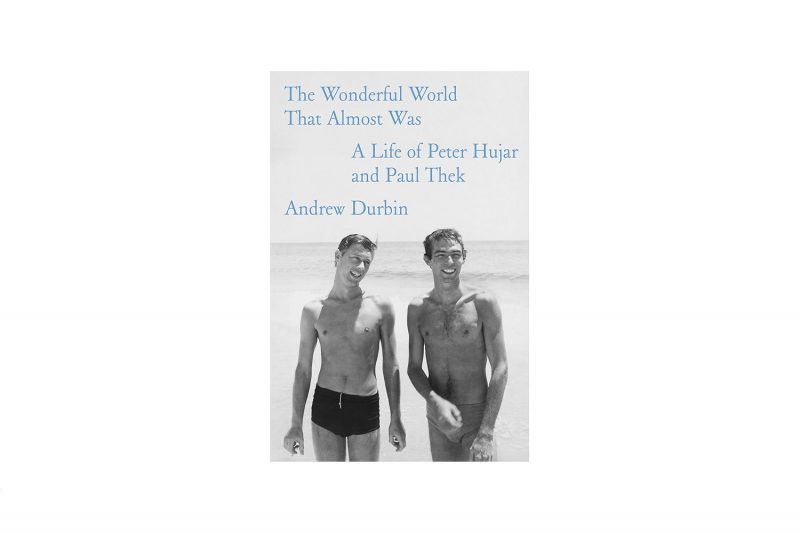
In some ways, Andrew Durbin’s The Wonderful World That Almost Was — A Life of Peter Hujar and Paul Thek follows that model. As is always the case in life, it’s the details that differ; as is always the case in good writing, it’s those very details that make all the difference.
Hujar and Thek knew each other very well. They were friends before they became lovers. Then, they became brothers (of sorts), and they ended up doing the things that brothers do when they are as similar and as different as these two were. They quarreled, they fought, they grew apart.
Hujar was a photographer, Thek a painter, sculptor, and occasional performance artist. It’s straightforward to claim that both Hujar and Thek are in serious need of a rediscovery. At their time, they were relatively well known, in particular in the New York City art scene in which they moved and worked. But with time and for different reasons, they were almost forgotten.
The larger backdrop against which the two lives unfold is provided by the United States in the mid 1950s up until the early 1980s. Hujar and Thek were gay. Thek’s sexuality included a bisexual component, even as at the time it was never clear to anyone involved — Thek as much as the women he pursued — to what extent it was real (Susan Sontag, for a while a close friend of both, noted that “his supposed desire for her was mostly a fiction” [p. 370]).
Hujar’s and Thek’s lives included the Stonewall Uprising, which marked a turning point in the history of LGBTQ+ civil rights in the United States (one of the many small and revealing details from the book is that Hujar took the photograph that was used for one of the posters for the very first Christopher Street Liberation Day March in 1970). But it also included the AIDS crisis in the 1980s, which cost both their lives.
Any person could only dream of having a biographer as tender, caring, and compassionate as Durbin. There is enormous love for these two artists throughout the book, a love that does not shy away from revealing the many rough edges in these artists’ lives that a lesser biographer would have either omitted or smoothed over.
The biography itself extends from 1954 until 1975. Hujar’s and Thek’s childhoods and deaths are relegated to a short introduction and an epilogue. The book thus covers the time period when Hujar and Thek entered each other’s orbits, to spin around each other, getting closer and closer while spinning faster and faster — until centrifugal forces of their own making tore them apart.
As it turned out, the for me most endearing and searing portrait of Thek by Hujar was taken in 1975 when the photographer was making work for what would be the sole photobook produced during his lifetime. By that time, the two brothers had already grown apart, and they loved and detested each other in equal measure — the kind of mix that ordinarily only exists between actual siblings but that these two somehow managed to conjure up for themselves.
The final chapter of the book details the making of the book and those particular photography sessions. “The camera and the heart,” Durbin writes of these sessions, “were not opposed ways of seeing but extensions of each other.” Given how the book unfolded up until that point, it’s very difficult to see how there could have come anything after (besides the Epilogue).
As an aside Durbin’s observation is also why I think Diane Arbus disliked Hujar’s work so much: it demonstrated that very fact, namely that the camera and the heart are connected — a damning realization in light of the cynical theater of cruelty in her own photographs. [see p. 222ff. for context].
Hujar and Thek struggled not only with the roles they were granted in a country that was a lot less accepting of LGBTQ+ people than it is now (of course, it still has ways to go). They also tried finding their places in the world of artists they largely operated in.
Parts of Hujar’s struggle are widely known: up until maybe the 1980s, photography was not widely considered as art. What might this even mean, a photograph as a piece of art? Susan Sontag was dismissive in her famous book, much to the chagrin of Hujar (Lisette Model dryly remarked: “This woman, she knows everything, but she understands nothing” [p. 376]).
Thek, in contrast, moved from painting to sculpture to what possibly might be best described as installations that involve performative aspects. He did not have to fight for his works to be accepted as art; it’s just that he was brushing mightily against many grains, making art that was often widely admired but that simply did not sell and that also did not quite fit into how the world of art thinks of its wares.
Neither man was easy to work with. Hujar detested the commercial and editorial photography he had to do for a long time. Thek mostly felt misunderstood. Both men had trouble making the kinds of compromises a successful career in the arts demanded (and still does). Highly considered by many of their peers and friends, with time they both were relegated more and more to the margins of the world they so eagerly had tried to fit in.
While reading the book, I felt that ultimately it provides more access to Thek. This might be a consequence of the fact that he left a lot more first-hand information for Durbin to get access to. Even as a lot of his art pieces are by now simply lost there are huge numbers of notebooks to read. Hujar, in contrast, cultivated an aura of aloofness (with an occasionally devilishly flaring hot temper mixed in).
Thek might have suffered from some form of mental disorder. Undiagnosed at the time, his friends and acquaintances suspected that something was amiss; in retrospect, it is difficult to know. It’s possible that it was bipolar disorder.
All of this combines to an extremely engaging portrait of two very talented and conflicted men whose lives chronicle a very specific moment in the history of the United States (and especially New York City). The Wonderful World That Almost Was sets a new standard for how artists — and in particular photographers — might be portrayed.
Even in its most revealing moments, the book never strays from the Durbin’s tender touch: people are, well, people. Even the most talented ones are as tormented and imperfect as the rest of us. In the end, we’re all just trying to get by, trying to be accepted not just for who we are but also, and crucially, who we want to be.
Highly recommended.
Andrew Durbin: The Wonderful World That Almost Was — A Life of Peter Hujar and Paul Thek; 496 pages; Farrar, Straus and Giroux; 2026
If you enjoyed this article, please consider subscribing to my Patreon. There, you will find exclusive articles, videos, and audio guides about the world of the photobook and more. For those curious, there now is the possibility of a trial membership for seven days.
Much like journalism, photography criticism involves a huge investment of time and resources. When you become a subscriber, you not only get access to more of my work. You will also help me produce it (including the free content on this site).
There also is a Mailing List, which I use to send out supplementary materials — anything that has me inspired or that somehow seemed worth noting. Some of it is serious, some is not. You can sign up for free here.
Thank you for your support!