I don’t know if you’ve noticed but our world isn’t doing so well. Even as there still is endless denial by fossil-fuel corporations and the politicians they’ve bought climate change has started to wreak havoc. In addition, in many places of the world freedom is retreating (the actual freedom, not the selective one that depends on who claims it).
It is becoming increasingly obvious that while democracy needs capitalism in a carefully tempered way to succeed, capitalism — especially not the rampant neoliberal one we have to live under — does not need democracy to succeed.
The world of art is largely the most impotent part of all of this. Oligarchs and plutocrats spend some of their money in order to decorate their homes and to elevate what their images (see the so-called Met Gala). But commercial aspects aside, art has no bearing on the world at large.
That, and I would argue only that, is what makes it so precious in this world. People make or look at art because it lifts them up (metaphorically speaking).
But the world of art is increasingly under attack because those in power operate under a devious assumption. They believe that they can partake in whatever they think art has to offer without having to deal with the reality of how and especially by whom art is being made.
For example, the Venice Biennial has come under fire because it is deemed to have become “too political”. The words “too political” always serve as markers for an agenda. In essence, those in power want their art and especially their artists to be the right kind of political.
For certain quarters (such as Germany’s ruling class [which is curiously unalarmed about the country’s reincarnated Nazi party polling at over 25%]), artists rejecting the participation of genocidal countries is “too political”. I suspect that those same people would still admire, say, Pablo Picasso’s Guernica. But that would only demonstrate that the outrage over art is always selective (insert *always has been* meme here), and it has nothing to do with art itself.
What is an artist to do? With time and age steadily advancing I have come to the conclusion that every artist will simply have to decide that question on their own, in the comfort of their own home (let’s keep in mind that some artists don’t have a home any longer because it was bombed to bits by one of the aforementioned genocidal countries).
If an artist has a responsibility to address this world’s larger ills, that responsibility can only ever be personal, meaning: arising from their own convictions. To demand more from artists places an unrealistic expectation on some of the most powerless people.
In terms of art itself, I am torn between two poles. I want art speaking to the dismay I feel watching vast parts of the world burn (whether literally or metaphorically). I want to experience art that expressly takes that fire as its subject matter (as I did myself with two of my photobooks).
On the other hand, I also want to experience art that does not take that fire as its subject matter, to instead focus on the frequent beauty that still exists in this world.
Of course, I want beauty in both cases: beauty can mean an infinity of things, which makes the concept itself, well, beautiful — while making the jobs of those writing about it a lot harder.
I understand why so many artists would rather not make work around the fires. To a large extent, the healing potential of art emerges when it offers solace to those making it. I definitely do not judge any artists for the choices they make concerning what to focus their attention on.
Still, I have massive respect for people like Matthew Connors who has taken his camera to some of the most contested places on this planet. These have included Egypt during its short-lived fight for freedom or Ukraine, whose people are under attack from one of those genocidal countries. Connors could be photographing sticks and stones, but he chooses not to.
The work in Egypt resulted in Fire in Cairo, a book around the events he witnessed and that was not only critically acclaimed but also won a few prestigious awards.
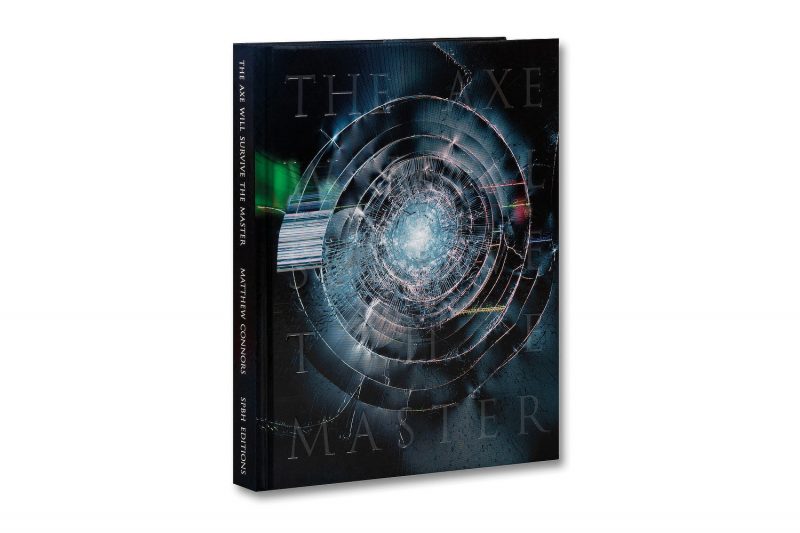
And now there is a new book that carries the somewhat unsubtle title The Axe Will Survive the Master. Of course, there’s absolutely nothing subtle about the people who govern this planet.
The Axe is a logical continuation of Fire in that the conflagration in the Egyptian capital in modified form has engulfed larger parts of the rest of the world.
The work was photographed in a number of places all across the globe (over the course of over a decade), and of course there are regional differences between those.
A photographer acting as an artist has to move from the simple descriptiveness of photographs towards distilling their own larger truth, and that is what Connors did here. In other words, where there are local markers in any of the photographs, the viewer is asked to look past those.
It’s straightforward to read The Axe as a description of the conflict between state power that sides with and defends capital (and nothing else) and an amorphous group of citizens opposed to having their rights and freedoms trampled.
It’s noteworthy to keep in mind how in Western media the framing around these kinds of events changes, depending on where people are taking to the streets to protest. In the West, typically the police are said to uphold the order which is under threat by demonstrators (who inevitably will be blamed for any violence). Elsewhere, though (such as in Hong Kong), the police are described as violently suppressing demonstrators’ rights.
In the book, Connors mixes photographs from places that through their media treatment usually are perceived as being different, alluding to a form of violence that is almost invisible: it’s not the physical violence playing out in the streets — it’s the structural violence that forces people into very limiting life situations.
The book does not aim to have its viewers arrive at any specific conclusion. Instead, it serves to build up an enormous unease, which, I think, is the only realistic goal an artist can have. That unease serves to counter the effects of what in different contexts I have termed photography’s neoliberal realism.
Bertold Brecht famously complained that a photograph of a factory was unable to tell its viewers anything about the mechanisms at play behind its walls (please excuse my loose paraphrasing). In the strictly Marxist terms Brecht was thinking in he was and is correct: photography can only show surfaces — and not abstract concepts.
But Brecht erred in that a photograph of a factory is indeed able to project some of the ideology behind it onto viewers. In our contemporary context, that’s what I described as neoliberal realism, in which photography communicates the power of capitalism: as someone embedded in it, you can either submit to it (and be one of the “winners” [at least in theory]), or you can reject it (and be one of the “losers”).
Contemporary capitalism has made full use of photography’s power. My favourite example is the much maligned Museum of Ice Cream. If as a viewer or critic you only focus on how ridiculous the idea might be or how it merely amplifies its visitors’ supposed narcissism, you’re missing the point entirely.
The Museum of Ice Cream does not celebrate ice cream. It also does not celebrate its visitors (who, in any case, are not any more narcissistic than the rest of us). Instead, it focuses on submission: visitors take their photographs, enjoying the experience, and then they share them. If you fully submit to a world in which the most prominent freedom is the one that allows you to decide what to consume, then you might as well enjoy it.
Another way of understanding the Museum of Ice Cream (and our neoliberal world in general) would be to see it as Disney World with the cartoon characters and stories removed: you’re left with pure aesthetics — great and easy to photograph, and the taking and sharing of those photographs demonstrates how much you enjoy your role in this system.
“The spectacle is the ruling order’s nonstop discourse about itself, its never-ending monologue of self-praise, its self-portrait at the stage of totalitarian domination of all aspects of life,” Guy Debord observed (in: The Society of the Spectacle, Bureau of Public Secrets, 2014, p. 7)
In other words, in our contemporary world it is incredibly easy to create work that essentially is neoliberal realism, regardless of whether you’re a visitor to the Museum of Ice Cream or a celebrated fine-art photographer showing up at a rave: it’s all just the same thing.
Photographing the spectacle or the facades that surround us on its/their own (and by this I mean without any intervention by the photographer) at best will generate pictures that can be read in two ways, namely as a celebration of the spectacle (and thus of neoliberal capitalism) or as a description of the spectacle (and then possibly, if you’re very generous, as what in the world of contemporary photography is seen as a form of criticism).
The problem is that the celebratory aspect never fully fades into the background. And even your criticism — assuming that’s intended — ultimately comes across as shallow. Neoliberal capitalism thus neuters photography — unless you work very hard to avoid this.
Since my book on neoliberal realism was published, a number of photographers have asked me whether it is possible to avoid producing it. Yes, of course it is.
In order to avoid replicating neoliberal realism, you have to understand two things. First, you must not focus solely on what the pictures look like. Instead, you have to understand the codes embedded in them. And second (and crucially), you will then have to use the photographs’ codes against them.
Using the codes embedded in photographs against the larger system is not particularly complicated; but of course, in reality it is because the spectacle that so inevitably is part of our contemporary world makes it difficult. Once you understand that larger parts of the world are constructed in such a fashion that they look great in pictures it’s not that difficult to get there.
And that is exactly what Matthew Connors has done in and with The Axe Will Survive the Master. Crucially, the subversion of the spectacle does not play out through the photographs of the protestors and/or the expressions of protests. Remember, you might see similar pictures in the news.
Instead, Connors is flipping the codes of neoliberal realism against themselves through individual framings and photographic choices but also through the juxtaposition of the individual photographs in the book.
It’s a form of photographic judo. Parts of judo rely on using an opponent’s movements against them: instead of trying to counteract a movement by trying to stop it you amplify it by using its built-in momentum (albeit in a fashion not intended by the opponent).
The visual codes of state violence only work as long as they remain within the frameworks we are so familiar with. The moment a different framework arises, viewers are forcefully snapped out of experiencing the familiar. Then, they will clearly see the sheer brutality they had been trained not to notice. (By the way, the most crucial and widely noted recent tool for this type of unmasking of state violence has been the smartphone with its built-in video function.)
The Axe Will Survive the Master is a book of and for this moment, even as we don’t know when — or how — it might end. We don’t know, yet, what might emerge from it. As I noted earlier, it’s not the artist’s task to tell us. Instead, it is their job to alert us to what is happening around us to make us see, to make us feel.
From seeing and feeling — and then from acting — something new might emerge. It’s up to all of us to make it happen.
Highly recommended.
The Axe Will Survive the Master; photographs and text by Matthew Connors; 208 pages; SPBH Editions/MACK; 2026
If you enjoyed this article, please consider subscribing to my Patreon. There, you will find exclusive articles, videos, and audio guides about the world of the photobook and more. For those curious, there now is the possibility of a trial membership for seven days.
Much like journalism, photography criticism involves a huge investment of time and resources. When you become a subscriber, you not only get access to more of my work. You will also help me produce it (including the free content on this site).
There also is a Mailing List, which I use to send out supplementary materials — anything that has me inspired or that somehow seemed worth noting. Some of it is serious, some is not. You can sign up for free here.
Thank you for your support!