The more I know about photography and the more I have become comfortable making my own photographs, the more I feel the need to experience its interactions with other human activities in which the reality that surrounds us is captured in some fashion.
As a visual person, I tend to think of the world first and foremost as being captured in images — short/brief fragments out of that much larger flow that we will never fully grasp. On their own, photographs can only do so much. But accompanied by something else — whether words, other non-photographic images, or other human artifacts — photographs’ deficiencies not only fall away: they become irrelevant.
For a long time, I thought that talent was driving art making. But talent is irrelevant without execution.
Then, I thought it was passion. But, again, passion is irrelevant without execution (and unlike talent, passion can be faked).
Now, I know that if anything matters in art, it’s the urgency felt by the person making something. Urgency knows no bounds. With bounds urgency ceases to exist — much like thirst vanishes after a drink.
This is what I am looking for in art: I want to feel that someone wants to urgently tell me something, something that cannot wait, something that cannot be fully expressed but that needs to be expressed regardless. That’s why I have no patience any longer for photographers illustrating ideas with pictures: it’s not the illustration part I mind (as bad as it is), it’s the complete lack of urgency behind it.
If you feel urgency behind your expression, you’re unable to illustrate. Illustrating your own pain, your suffering, your joy, your exuberance falls so short of conveying it — even though you will never reach it, you still want to reach out for that larger expression beyond illustration.
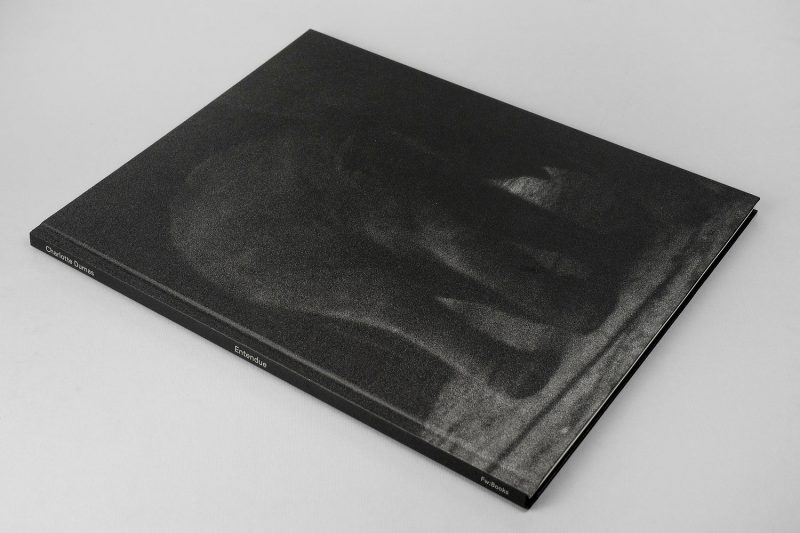
Charlotte Dumas‘ Entendue is a collaboration after the fact, the fact here being the collaborator’s death — and the collaborator being the photographer’s late father, himself a graphic artist and painter. For the collaboration, Dumas used one of her father’s cameras, and she included some of her father’s drawings and sketches alongside her own photographs and drawings.
With so much of this photographer’s work being centered on animals, the subjects of the book — elephants — will come as no surprise. “When I was a child,” she writes, “my father would take me to Diergaarde Bijdorp, the zoo in Rotterdam and we’d sketch the elephants together.”
In the book, the elephants are being sketched together by these two artists again, one final time.
In her words, Dumas speaks forcefully of her hope that the work may guide people to “a deeper understanding of humans and elephants”. I don’t know whether photographs or drawings can do that.
What these photographs and drawings do, though, is to speak of the urgency felt when making the work, putting it together, and releasing it into the world. One final collaboration between a father and his daughter.
Faced with photographs or drawings, comprehension must inevitably fail at some point. No photograph will be able to convey the truth of the world to us. The best anyone can hope for is for it to convey fragments of a truth.
But we want to understand even as we know that we will not be able to, especially when faced with the cruelest of experiences, the loss of a loved one.
Death is the ultimate entity that will forever separate us from what we know and what we hope we might know.
So even though you could approach the book and hope to learn more about elephants, to understand better how to relate to them, I would probably suggest to simply feel the emotions that run through the pages of this book.
That’s the thing about that urgency I spoke of above: it’s impossible to put it into the pictures, but it’s equally impossible to hide it from the pictures.
Grief can take many forms and is impossible to control; but it can also result in deeply meaningful art being made — as is the case here.
Entendue; photographs and drawings by Charlotte and Peter Dumas; short text by Charlotte Dumas; 64 pages; FW:Books; 2025
If you enjoyed this article, please consider subscribing to my Patreon. There, you will find exclusive articles, videos, and audio guides about the world of the photobook and more. For those curious, there now is the possibility of a trial membership for seven days.
Much like journalism, photography criticism involves a huge investment of time and resources. When you become a subscriber, you not only get access to more of my work. You will also help me produce it (including the free content on this site).
There also is a Mailing List, which I use to send out supplementary materials — anything that has me inspired or that somehow seemed worth noting. Some of it is serious, some is not. You can sign up for free here.
Thank you for your support!